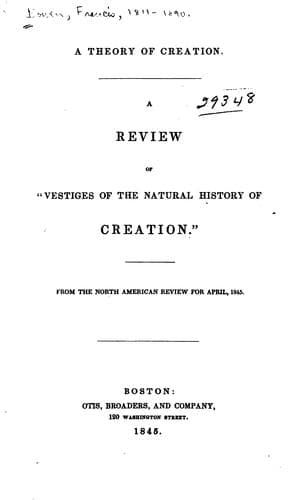
A Theory of Creation: A Review of 'Vestiges of the Natural History of Creation' — John Shaqi
A Theory of Creation: A Review of 'Vestiges of the Natural History of Creation'Bowen, Francis
Religion
A Theory of Creation: A Review of 'Vestiges of the Natural History of Creation'
Bowen, Francis
Chambers, Robert, 1802-1871. Vestiges of the natural history of creation; Creation; Evolution (Biology)
It happens that we are not obliged to grant to our author an indefinite
lapse of ages for the sake of bringing all his higher principles into
action. One of the latest events in the geological history of the earth
was a great submersion of the land, by which "terrestrial animal life
was extensively, if not universally, destroyed"; so that the creation of
the species now in being--at least, all the higher species--was "a
comparatively recent event, and one posterior, generally speaking, to
all the great natural transactions chronicled by geology." Science does
not contradict, it rather confirms, that voice of revelation or
tradition, which assigns about six thousand years as the period of man's
residence upon the earth. The action of the drama, then, is restricted
within moderate limits as to time, and the "natural agencies" and
"higher principles" must work fast in order to accomplish their task
within the prescribed period. One condition for the creation of a new
and permanent species, belonging to any of the higher orders, seems to
have escaped our author's notice; at least two individuals, a male and a
female, must have been evolved out of the next lower race, before the
new species could continue its kind. Apply these considerations to the
creation of man, who, according to our author's Scripture, was born of a
monkey. To suppose, that, at the first trial, an Adam and an Eve were
born near each other, so that they might have a chance of meeting in the
course of their lives, would look too much like the operation of
intelligence and design. On the theory of an organic creation by law, as
the monkey race is spread over large regions of the globe, we must
suppose that many of each sex were produced, and died childless, before
any Adam was happy enough to find an Eve. Then, at no very distant
period, within a few thousand years, the birth of a man from an animal
of a lower type was no very strange event. Probably it occurred so
often, that the monkeys themselves ceased to be astonished at it. And
yet, this tribe of animals, with all the benefit of large experience,
with increased numbers, and with all the requisite conditions fulfilled
at least as perfectly as they were at the earlier period of their
history, have not succeeded, in the three or four thousand years during
which they have been subject to the observation of intelligent beings,
in producing even a decent semblance of a man.
Public-domain text, read in full here on John Shaqi.
Reviews
Reviews
No reviews yet
Be the first to share your thoughts on this work.
Join the Discussion
Join the discussion
Sign in to leave a comment or review.
Sign InorCreate an account