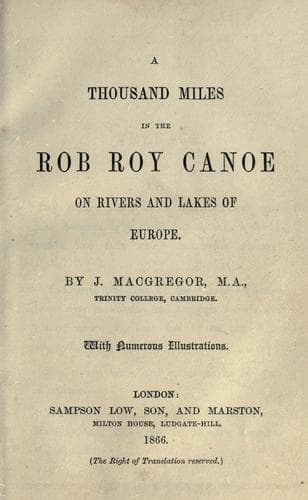
A Thousand Miles in the Rob Roy Canoe on Rivers and Lakes of EuropeMacGregor, John
History
A Thousand Miles in the Rob Roy Canoe on Rivers and Lakes of Europe
MacGregor, John
Canoes and canoeing -- Europe; Europe -- Description and travel; History -- Miscellanea; MacGregor, John, 1825-1892 -- Travel -- Europe
"Why," said I, "look at these hens; I am sure they have laid six eggs
this morning, they seem so conceited."
She evidently thought I was a tramp demanding alms, and when told to
look at the boat which had come from England, she said she was too old
and too blind to see. However, we managed to make an omelette together,
and she stood by (with an eye, perhaps, to her only fork) and chatted
pleasantly, asking, "What have you got to sell?" I told her I had come
there only for pleasure. "What sort of pleasure, Monsieur, can you
possibly hope to find in _this_ place?" But I was far too gallant to say
bluntly that her particular mansion was not the ultimate object of the
tour. After receiving a franc for the rough breakfast, she kept up a
battery of blessings till the Rob Roy started, and she ended by
shrieking out to a navvy looking on, "I tell you every Englishman is
rich!"
Next day was bright and blue-skyed as before, and an early start got the
fine fresh morning air on the water.
The name of this river is sometimes pronounced "Moselle," and at other
times "Mosel," what we should call "Mozle." When a Frenchman speaks of
"la Moselle," he puts an equal emphasis on each of the three syllables
he is pronouncing; whereas generally we Englishmen call this river
Mosélle.
The name of a long river often indeed goes through changes as it
traverses various districts and dialects; for instance, the Missouri,
which you hear the travellers in Kansas call "Mzoory," while they wend
along the Californian road.
When the scenery is tame to the canoist, and the channel of the river is
not made interesting by dangers to be avoided, then one can always turn
again to the animals and birds, and five minutes of watching will be
sure to see much that is curious.
Here, for instance, we have the little kingfisher again, who had met us
on the Danube and the Reuss, and whom we knew well in England before;
but now we are on a visit to _his_ domain, and we see him in his private
character alone. There are several varieties of this bird, and they
differ in form and colour of plumage. This "Royal bird," the _Halcyon_
of antiquity, the _Alcedo_ in classic tongue, is called in German "Eis
fogl," or "Ice bird," perhaps because he fishes even in winter's frost,
or because his nest is like a bundle of icicles, being made of minnows'
bones most curiously wrought together.
But now it is on a summer day, and he is perched on a twig within two
inches of the water, and under the shade of a briar leaf, his little
parasol. He is looking for fish, and is so steady that you may easily
pass him without observing that brilliant back of azure, or the breast
of blushing red.
When I desired to see these birds, I quietly moved my boat till it
grounded on a bank, and, after it was stationary thus for a few minutes,
the Halcyon fisher got quite unconcerned, and plied his task as if
unseen.
Public-domain text, read in full here on John Shaqi.
Reviews
Reviews
No reviews yet
Be the first to share your thoughts on this work.
Elsewhere in the archive
Join the Discussion
Join the discussion
Sign in to leave a comment or review.
Sign InorCreate an account