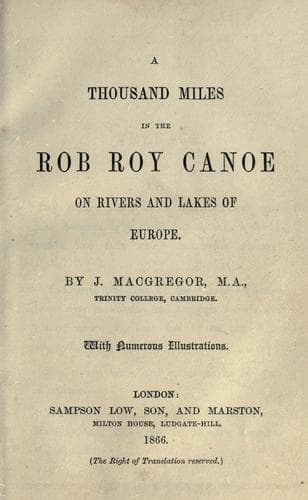
A Thousand Miles in the Rob Roy Canoe on Rivers and Lakes of EuropeMacGregor, John
History
A Thousand Miles in the Rob Roy Canoe on Rivers and Lakes of Europe
MacGregor, John
Canoes and canoeing -- Europe; Europe -- Description and travel; History -- Miscellanea; MacGregor, John, 1825-1892 -- Travel -- Europe
In the next quiet bay a village maid drives her cow to the river, and
chats across the water with another, also leading in a cow to wade knee
deep, and to dip its broad nose, and lift it gently again from the cool
stream. On the road alongside is a funny little waggon, and a whole
family are within. This concern is actually drawn along by a goat. Its
little kid skips about, for the time of toil has not yet come to the
youngling, and it may gambol now.
But here is the bridge of Nogent, so I leave my boat in charge of an old
man, and give positive pleasure to the cook at the auberge by ordering a
breakfast. Saints' portraits adorn the walls, and a "sampler" worked by
some little girl, with only twenty-five letters in the alphabet, for the
"w" is as yet ignored in classic grammars, though it has now to be
constantly used in the common books and newspapers. Why, they even adopt
our sporting terms, and you see in a paper that such a race was only "un
Walkover," and that another was likely to be "un dead heat."
Suddenly in my quiet paddling here the sky was shaded, and on looking up
amazed I found a cloud; at last, after six weeks of brilliant blue and
scorching glare, one fold of the fleecy curtain has been drawn over the
sun.
The immediate effect of this cooler sky was very invigorating, though,
after weeks of hot glare (reflected upwards again into the face from
the water), it seemed the most natural thing to be always in a blaze of
light, for much of the inconvenience of it was avoided by a plan which
will be found explained in the Appendix, with some other hints to
"Boating Men."
The day went pleasantly now, and with only the events of ordinary times,
which need not be recounted. The stream was steady, the banks were
peopled, and many a blue-bloused countryman stopped to look at the canoe
as she glided past, with the captain's socks and canvas shoes on the
deck behind him, for this was his drying-place for wet clothes.
Now and then a pleasure-boat was seen, and there were several canoes at
some of the towns, but all of them flat-bottomed and open, and
desperately unsafe--well named "perissoirs." Some of these were made of
metal. The use of this is well-known to be a great mistake for any boat
under ten tons; in all such cases it is much heavier than wood of the
same strength, considering the strains which a boat must expect to
undergo.
"La Ferté sous Jouarre" is the long name of the next stopping-place.
There are several towns called by the name La Ferté (La Fortifié), which
in some measure corresponds with the termination "caster" or "cester" of
English names. Millstones are the great specialty of this La Ferté. A
good millstone costs 50_l._, and there is a large exportation of them.
The material has the very convenient property of not requiring to be
chipped into holes, as these exist in this stone naturally.
Public-domain text, read in full here on John Shaqi.
Reviews
Reviews
No reviews yet
Be the first to share your thoughts on this work.
Elsewhere in the archive
Join the Discussion
Join the discussion
Sign in to leave a comment or review.
Sign InorCreate an account