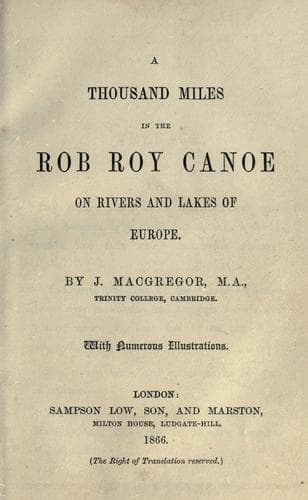
A Thousand Miles in the Rob Roy Canoe on Rivers and Lakes of EuropeMacGregor, John
History
A Thousand Miles in the Rob Roy Canoe on Rivers and Lakes of Europe
MacGregor, John
Canoes and canoeing -- Europe; Europe -- Description and travel; History -- Miscellanea; MacGregor, John, 1825-1892 -- Travel -- Europe
[Illustration]
APPENDIX.
GOSSIP ASHORE ABOUT THINGS AFLOAT.
Those who intend to make a river voyage on the Continent--and several
canoes are preparing for this purpose--will probably feel interested in
some of the following information, while other readers of these pages
may be indulgent enough to excuse the relation of a few particulars and
technical details.
It is proposed, then, to give, first, a description of the canoe
considered to be most suitable for a voyage of this sort after
experience has aided in modifying the dimensions of the boat already
used; second, an inventory of the cargo or luggage of the Rob Roy, with
remarks on the subject, for the guidance of future passengers.
Next there will be found some notes upon rocks and currents in broken
water; and lastly, some further remarks on the "Kent," and a few
miscellaneous observations upon various points.
Although the Rob Roy and its luggage were not prepared until after much
cogitation, it is well that intending canoists should have the benefit
of what experience has since proved as to the faults and virtues of the
arrangements devised for a first trip, after these have been thoroughly
tasted in so pleasant a tour.
The best dimensions for the canoe appear to be--length, 14 feet
[15][XXXVI.]; beam, 26 inches [28], six inches abaft the midship; depth
outside, from keel to deck, 9 inches; camber, 1 inch [2]; keel, 1 inch,
with a strip of iron, half an inch broad, carefully secured all the way
below, and a copper strip up the stem and stern posts, and round the top
of each of them.
[XXXVI.] The figures in [ ] are the dimensions of the old Rob Roy.
The new canoe now building will have the beam at the water's edge, and
the upper plank will "topple in," so that the cedar deck will be only 20
inches wide.
The "well" or opening in the deck should be 4 feet long [4 feet 6
inches] and 20 inches wide, with a strong combing all round, sloping
forward, but not more than 1 inch [2] high at the bow end. This opening
should be semicircular at the ends, both for appearance sake and
strength and convenience, so as to avoid corners. The macintosh sheet to
cover this must be strong, to resist constant wear, light coloured, for
the sun's heat, and so attached as to be readily loosened and made fast
again, say 20 times a day, and by cords which will instantly break if
you have to jump out. In the new canoe this macintosh (the most
difficult part of the equipment to arrange) is 18 inches long, and a
light wooden hatch covers the fore part, an arrangement found to be most
successful.
A water-tight compartment in the hull is a mistake. Its partition
prevents access to breakages within, and arrests the circulation of air,
and it cannot be kept long perfectly staunch. There should be extra
timbers near the seat.
Public-domain text, read in full here on John Shaqi.
Reviews
Reviews
No reviews yet
Be the first to share your thoughts on this work.
Elsewhere in the archive
Join the Discussion
Join the discussion
Sign in to leave a comment or review.
Sign InorCreate an account