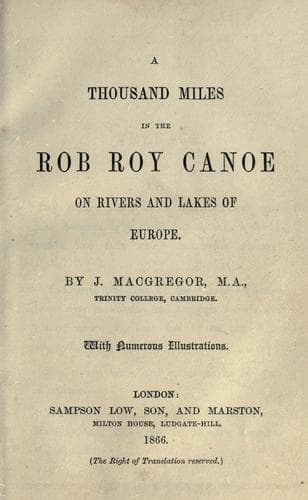
A Thousand Miles in the Rob Roy Canoe on Rivers and Lakes of EuropeMacGregor, John
History
A Thousand Miles in the Rob Roy Canoe on Rivers and Lakes of Europe
MacGregor, John
Canoes and canoeing -- Europe; Europe -- Description and travel; History -- Miscellanea; MacGregor, John, 1825-1892 -- Travel -- Europe
The moment I got into my boat again a shrill whining cry in the river
attracted my attention, and it came from a poor little boy, who had
somehow fallen into the water, and was now making his last faint efforts
to cling to a great barge in the stream. Naturally I rushed over to save
him, and my boat went so fast and so straight that its sharp prow caught
the hapless urchin in the rear, and with such a pointed reminder too
that he screamed and struggled and thus got safely on the barge, which
was beyond his reach, until thus roughly but fortunately aided.
On most of the Belgian, German, and French rivers there are excellent
floating baths, an obvious convenience which I do not recollect
observing on a single river in Britain, though in summer we have quite
as many bathers as there are abroad.
The floating baths consist of a wooden framework, say 100 feet long,
moored in the stream, and through which the water runs freely, while a
set of strong bars and chains and iron network forms a false bottom,
shallow at one end and deeper at the other, so that the bather cannot be
carried away by the current.
Round the sides there are bathing boxes and steps, ladders, and spring
boards for the various degree of aquatic proficiency.
The youths and even the little boys on the Rhine are very good swimmers,
and many of them dive well. Sometimes there is a ladies' bath of similar
construction, from which a good deal of very lively noise may be heard
when the fair bathers are in a talkative mood.
The soldiers at military stations near the rivers are marched down
regularly to bathe, and one day we found a large number of young
recruits assembled for their general dip.
While some were in the water others were firing at the targets for ball
practice. There were three targets, each made of cardboard sheets,
fastened upon wooden uprights. A marker safely protected in a ball-proof
_mantelet_ was placed so close to these targets that he could see all
three at once. One man of the firing party opposite each target having
fired, his bullet passed through the pasteboard and left a clear round
hole in it, while the ball itself was buried in the earth behind, and
so could be recovered again, instead of being dashed into fragments as
on our iron targets, and then spattered about on all sides, to the great
danger of the marker and everybody else.
When three men had thus fired, signals were made by drum, flag, and
bugle, and the firing ceased. The marker then came out and pointed to
the bullet-mark on each target, and having patched up the holes he
returned within his mantelet, and the firing was resumed. This very safe
and simple method of ball practice is much better than that used in our
military shooting.
Public-domain text, read in full here on John Shaqi.
Reviews
Reviews
No reviews yet
Be the first to share your thoughts on this work.
Join the Discussion
Join the discussion
Sign in to leave a comment or review.
Sign InorCreate an account