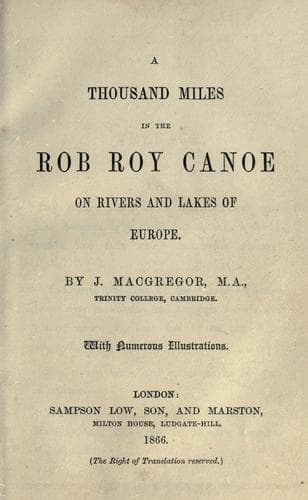
A Thousand Miles in the Rob Roy Canoe on Rivers and Lakes of EuropeMacGregor, John
History
A Thousand Miles in the Rob Roy Canoe on Rivers and Lakes of Europe
MacGregor, John
Canoes and canoeing -- Europe; Europe -- Description and travel; History -- Miscellanea; MacGregor, John, 1825-1892 -- Travel -- Europe
(_b_) It has been said that the constant use of a canoe paddle must
contract the chest, but this is certainly a mistake. If, indeed, you
merely dabble each blade of the paddle in the water without taking the
full length of the stroke the shoulders are not thrown back, and the
effect will be injurious; but exactly the same is true if you scull or
row with a short jerky stroke.
In a proper use of the paddle the arms ought to be in turn fully
extended, and then brought well back, so that the hand touches the side,
and the chest is then well plied in both directions.
In using the single-bladed paddle, of which I have had experience in
Canada and New Brunswick with the Indians in bark canoes and log canoes,
there seems to be a less beneficial action on the pectoral muscles, but
after three months' use of the double paddle I found the arms much
strengthened, while clothes that fitted before were all too narrow round
the chest when put on after this exercise.
(_c_) In shallow water the paddle should be clasped lightly, so that if
it strikes the bottom or a rock the hand will yield and not the blade be
broken.
Great caution should be used when placing the blade in advance to meet a
rock, or even a gravel bank, otherwise it gets jammed in the rock or
gravel, or the boat overrides it.
It is better in such a case to retard the speed rather by dragging the
paddle (tenderly), and always with its flat side downwards, so that the
edge does not get nipped.
(_d_) M. Farcôt, a French engineer, has lately exhibited on the Thames a
boat which is rowed by the oarsman sitting with his face to the bow, who
by this means secures one of the advantages of the canoe--that of seeing
where you are going.
To effect this, a short prop or mast about three feet high is fixed in
the boat, and the two sculls are jointed to it by their handles, while
their weight is partly sustained by a strong spiral spring acting near
the joint, and in such a manner as to keep the blade of the scull a few
inches from the surface of the water when it is not pressed down
purposely.
The sculler then sits with his face towards the mast and the bow, and he
holds in each hand a rod jointed to the loom of the corresponding scull.
By this means each scull is moved on the mast as a fulcrum with the
power applied between that and the water. The operation of feathering is
partially performed, and to facilitate this there is an ingeniously
contrived guide.
This invention appears to be new, but it is evident that the plan
retains many of the disadvantages of common sculls, and it leaves the
double paddle quite alone as a simple means for propelling a canoe in
narrow or tortuous channels, or where it has to meet waves, weeds,
rocks, or trees, and moreover has to sail.
Public-domain text, read in full here on John Shaqi.
Reviews
Reviews
No reviews yet
Be the first to share your thoughts on this work.
Elsewhere in the archive
Join the Discussion
Join the discussion
Sign in to leave a comment or review.
Sign InorCreate an account