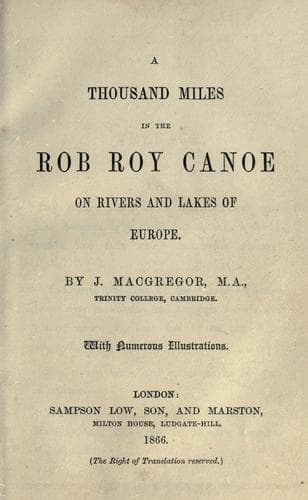
A Thousand Miles in the Rob Roy Canoe on Rivers and Lakes of EuropeMacGregor, John
History
A Thousand Miles in the Rob Roy Canoe on Rivers and Lakes of Europe
MacGregor, John
Canoes and canoeing -- Europe; Europe -- Description and travel; History -- Miscellanea; MacGregor, John, 1825-1892 -- Travel -- Europe
However, the muscular power of the arms can be applied with good effect
in this new manner, and I found it not very difficult to learn the use
of this French rowing apparatus, which is undoubtedly very ingenious,
and deserves a full trial before a verdict is pronounced.
(_e_) In a difficult place where the boat is evidently going too near a
rock, the disposition of the canoist is to change the direction by a
_forward_ stroke on one side, but this adds to the force with which a
collision may be invested. It is often better to _back_ a stroke on the
other side, and thus to lessen this force; and this is nearly always
possible to be done even when the boat appears to be simply drifting on
the stream. In fact, as a maxim, there is always steerage way sufficient
to enable the paddle to be used exactly as a rudder.
(_f_) When there is a brilliant glare of the sun, and it is low, and
directly in front, and it is impossible to bear its reflection on the
water, a good plan is to direct the bow to some point you are to steer
for, and then observe the reflection of the sun on the cedar deck of the
boat. Having done this you may lower the peak of your hat so as to cut
off the direct rays of the sun, and its reflected rays on the water,
while you steer simply by the light on the deck.
(_g_) When a great current moves across a river to a point where it
seems very unlikely to have an exit, you may be certain that some
unusual conformation of the banks or of the river bed will be found
there, and caution should be used in approaching the place. This,
however, is less necessary when the river is deep. Such cross currents
are frequent on the Rhine, but they result merely from unevenness in the
bottom far below, and thus we see how the rapids, most dangerous when
the river is low, become quite agreeable and safe in high flood time.
(_h_) The ripple and bubbles among weeds are so totally different from
those on free water that their appearance at a distance as a criterion
of the depth, current, and direction of the channel must be learned
separately. In general, where weeds are under water, and can sway or
wave about, there will be water enough to pass--the requisite 3 inches.
Backing up stream against long weeds is so troublesome, and so sure to
sway the stern round athwart stream, that it is best to force the boat
forward instead, even if you have to get out and pull her through.
(_i_) Paddling through rushes, or flags, or other plants above the
water, so as to cut off a corner, is a mistake. Much more "way" is lost
then by the friction than might be supposed.
Public-domain text, read in full here on John Shaqi.
Reviews
Reviews
No reviews yet
Be the first to share your thoughts on this work.
Elsewhere in the archive
Join the Discussion
Join the discussion
Sign in to leave a comment or review.
Sign InorCreate an account