Whether he was essentially author turned farmer, or farmer turned author,
Arthur Young has the first place in English literature as a
farmer-author. Other practical men have written practical books of
permanent value, which have places of honour in the literature of the
farm; but Arthur Young's writings have won friends for themselves among
readers of every class, and belong more broadly to the literature of the
country.
Between 1766 and 1775 he says that he made 3,000 pounds by his
agricultural writings. The pen brought him more profit than the plough.
He took a hundred acres in Hertfordshire, and said of them, "I know not
what epithet to give this soil; sterility falls short of the idea; a
hungry vitriolic gravel--I occupied for nine years the jaws of a wolf. A
nabob's fortune would sink in the attempt to raise good arable crops in
such a country. My experience and knowledge had increased from
travelling and practice, but all was lost when exerted on such a spot."
He tried at one time to balance his farm losses by reporting for the
_Morning Post_, taking a seventeen-mile walk home to his farm every
Saturday night.
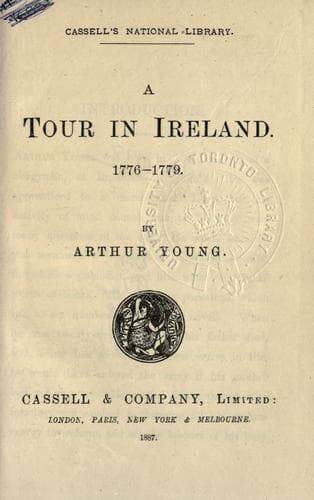
In 1780 Arthur Young published this "Tour in Ireland, with General
Observations on the Present State of that Kingdom in 1776-78." The
general observations, which give to all his books a wide general
interest, are, in this volume, of especial value to us now. It is here
reprinted as given by Pinkerton.
In 1784 Arthur Young began to edit "Annals of Agriculture," which were
continued through forty-five volumes. All writers in it were to sign
their names, but when His Majesty King George III. contributed a
description of Mr. Duckett's Farm at Petersham, he was allowed to sign
himself "Ralph Robinson of Windsor."
In 1792 Arthur Young published the first quarto volume, and in 1794 the
two volumes of his "Travels during the years 1787-8-9 and 1790,
undertaken more particularly with a view of ascertaining the Cultivation,
Wealth, Resources and National Prosperity of the Kingdom of France."
This led to the official issue in France in 1801, by order of the
Directory, of a translation of Young's agricultural works, under the
title of "Le Cultivateur Anglais." Arthur Young also corresponded with
Washington, and received recognition from the Empress Catherine of
Russia, who sent him a gold snuff-box, and ermine cloaks for his wife and
daughter. He was made a Fellow of the Royal Society.
In 1793 his labours led to the formation of a Board of Agriculture, of
which he was appointed secretary.
Public-domain text, read in full here on John Shaqi.
Reviews
Reviews
No reviews yet
Be the first to share your thoughts on this work.
Join the Discussion
Join the discussion
Sign in to leave a comment or review.
Sign InorCreate an account