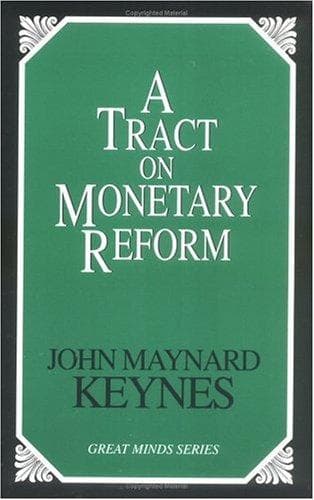
If the Government of India had been successful in stabilising the
rupee-sterling exchange, they would necessarily have subjected India to
a disastrous price fluctuation comparable to that in England. Thus the
unthinking assumption, in favour of the restoration of a fixed exchange
as the one thing to aim at, requires more examination than it sometimes
receives.
Especially is this the case if the prospect that a majority of
countries will adopt the same standard is still remote. When by
adopting the gold standard we could achieve stability of exchange
with almost the whole world, whilst any other standard would have
appeared as a solitary eccentricity, the solid advantages of certainty
and convenience supported the conservative preference for gold.
Nevertheless, even so, the convenience of traders and the primitive
passion for solid metal might not, I think, have been adequate
to preserve the dynasty of gold, if it had not been for another,
half-accidental circumstance; namely, that for many years past gold had
afforded not only a stable exchange but, on the whole, a stable price
level also. In fact, the choice between stable exchanges and stable
prices had not presented itself as an acute dilemma. And when, prior to
the development of the South African mines, we seemed to be faced with
a continuously falling price level, the fierceness of the bimetallic
controversy testified to the discontent provoked as soon as the
existing standard appeared seriously incompatible with the stability of
prices.
Indeed, it is doubtful whether the pre-war system for regulating the
international flow of gold would have been capable of dealing with such
large or sudden divergencies between the price levels of different
countries as have occurred lately. The fault of the pre-war régime,
under which the rates of exchange between a country and the outside
world were fixed, and the internal price level had to adjust itself
thereto (_i.e._ was chiefly governed by external influences), was that
it was too slow and insensitive in its mode of operation. The fault
of the post-war régime, under which the price level mainly depends on
internal influences (_i.e._ internal currency and credit policy) and
the rates of exchange with the outside world have to adjust themselves
thereto, is that it is too rapid in its effect and over-sensitive, with
the result that it may act violently for merely transitory causes.
Nevertheless, when the fluctuations are large and sudden, a quick
reaction is necessary for the maintenance of equilibrium; and the
necessity for quick reaction has been one of the factors which have
rendered the pre-war method inapplicable to post-war conditions, and
have made every one nervous of proclaiming a final fixation of the
exchange.
Public-domain text, read in full here on John Shaqi.
Reviews
Reviews
No reviews yet
Be the first to share your thoughts on this work.
Elsewhere in the archive
Join the Discussion
Join the discussion
Sign in to leave a comment or review.
Sign InorCreate an account