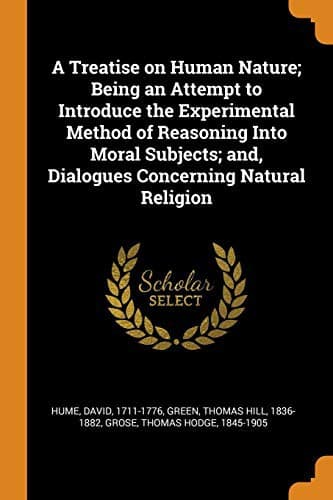
A Treatise of Human Nature: Being an Attempt to Introduce the Experimental Method Into Moral Subjects; and Dialogues Concerning Natural ReligionHume, David
PhilosophyPhilosophy
A Treatise of Human Nature: Being an Attempt to Introduce the Experimental Method Into Moral Subjects; and Dialogues Concerning Natural Religion
Hume, David
Emotions; Ethics; Knowledge, Theory of; Philosophy, English
117. But though the distinction between different kinds of knowledge
in regard to reality cannot but rest on the same principle as that
drawn between different kinds of ideas in the same regard, it is
to be noticed that in the doctrine of the Fourth Book ‘knowledge
concerning substances,’ in contrast with that in which ‘our thoughts
terminate in the abstract ideas,’ has by itself to cover the ground
which, in the Second and Third Book, simple ideas and complex
ideas of substances cover together. This is to be explained by the
observation, already set forth at large, [1] that the simple idea
has in Locke’s Fourth Book become explicitly what in the previous
books it was implicitly, not a feeling proper, but the conscious
reference of a feeling to a thing or substance. Only because it is
thus converted, as we have seen, can it constitute the beginning
of a knowledge which is not a simple idea but a conscious relation
between ideas, or have (what yet it must have if it can be expressed
in a proposition) that capacity of being true or false, which implies
‘the reference by the mind of an idea to something extraneous to it.’
(Book II. chap, xxxii. sec. 4.) Thus, what is said of the ‘simple
idea’ in the Second and Third Books, is in the Fourth transferred to
one form of knowledge concerning substances, to that, namely, which
consists in ‘particular experiment and observation,’ and is expressed
in singular propositions, such as ‘this is yellow,’ ‘this gold is
now solved in aqua regia.’ Such knowledge cannot but be real, the
proposition which expresses it cannot but have _real_ certainty,
because it is the effect of a ‘body actually operating upon us’
(Book IV. chap. xi. sec. 1), just as the simple idea is an ectype
directly made by an archetype. It is otherwise with complex ideas of
substances and with general knowledge or propositions about them.
A group of ideas, each of which, when first produced by a ‘body,’
has been real, when retained in the mind as representing the body,
becomes unreal. The complex idea of gold is only a nominal essence
or the signification of a name; the qualities which compose it are
merely ideas in the mind, and that general truth which consists in a
correct statement of the relation between one of them and another or
the whole--_e.g._, ‘gold is soluble in aqua regia’--holds merely for
the mind; [2] but it is not therefore to be classed with those other
mental truths, which constitute mathematical and moral knowledge,
and which, just because ‘merely ideal,’ are therefore real. Its
merely mental character renders it in Locke’s language a ‘trifling
proposition,’ but does not therefore save it from being _really_
untrue. It is a ‘trifling proposition,’ for, unless solubility in
aqua regia is included in the complex idea which the sound ‘gold’
stands for, the proposition which asserts it of gold is not certain,
not a truth at all. If it is so included, then the proposition is
Public-domain text, read in full here on John Shaqi.
Reviews
Reviews
No reviews yet
Be the first to share your thoughts on this work.
Elsewhere in the archive
Join the Discussion
Join the discussion
Sign in to leave a comment or review.
Sign InorCreate an account