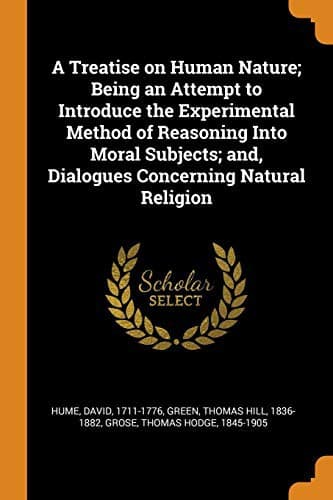
A Treatise of Human Nature: Being an Attempt to Introduce the Experimental Method Into Moral Subjects; and Dialogues Concerning Natural ReligionHume, David
PhilosophyPhilosophy
A Treatise of Human Nature: Being an Attempt to Introduce the Experimental Method Into Moral Subjects; and Dialogues Concerning Natural Religion
Hume, David
Emotions; Ethics; Knowledge, Theory of; Philosophy, English
but ‘playing with sounds.’ It may serve to remind an opponent of
a definition which he has made but is forgetting, but ‘carries no
knowledge with it but of the signification of a word, however certain
it be.’ (Book IV. chap. viii. secs. 5 & 9.) Yet there is a real gold,
outside the mind, of which the complex idea of gold in the mind must
needs try to be a copy, though the conditions of real existence are
such that no ‘complex idea in the mind’ can possibly be a copy of
it. Thus the verbal truth, which general propositions concerning
substances express, is under a perpetual doom of being really untrue.
The exemption of mathematical and moral knowledge from this doom
remains an unexplained mercy. Because merely mental, such knowledge
is real--there being no reality for it to _mis_represent--and yet
not trifling. The proposition that ‘the external angle of all
triangles is bigger than either of the opposite internal angles,’
has that general certainty which is never to be found but in our
ideas, yet ‘conveys instructive real knowledge,’ the predicate
being ‘a necessary consequence of precise complex idea’ which forms
the subject, yet ‘not contained in it.’ (Book IV. chap. viii. sec.
8.) [3] The same might be said apparently, according to Locke’s
judgment (though he is not so explicit about this), of a proposition
in morals, such as ‘God is to be feared and obeyed by man.’ (Book
IV. chap. xi. sec. 13.) [4] But how are such propositions, at once
abstract and real, general and instructive, to be accounted for?
There is no ‘workmanship of the mind’ recognised by Locke but that
which consists in compounding and abstracting (_i.e._, separating)
ideas of which ‘it cannot originate one.’ The ‘abstract ideas’
of mathematics, the ‘mixed modes’ of morals, just as much as the
ideas of substances, must be derived by such mental artifice from
a material given in simple feeling, and ‘real’ because so given.
Yet, while this derivation renders ideas of substances unreal in
contrast with their real ‘originals,’ and general propositions about
them ‘trifling,’ because, while ‘intimating an existence,’ they
tell nothing about it, on the other hand it actually constitutes
the reality of moral and mathematical ideas. Their relation to an
original disappears; they are themselves archetypes, from which the
mind, by its own act, can elicit other ideas not already involved
in the meaning of their names. But this can only mean that the mind
has some other function than that of uniting what it has ‘found’ in
separation, and separating again what it has thus united--that it can
itself originate.
[1] See above, paragraph 25.
[2] Book IV. chap. xi. sec. 13, xii. 9, &c.
[3] Just as according to Kant such a proposition expresses a judgment
‘synthetical,’ yet ‘á-priori.’
[4] Cf. Book IV. chap. iii. sec. 18, and Book III. chap, xi. sec. 16.
Significance of this doctrine.
Public-domain text, read in full here on John Shaqi.
Reviews
Reviews
No reviews yet
Be the first to share your thoughts on this work.
Elsewhere in the archive
Join the Discussion
Join the discussion
Sign in to leave a comment or review.
Sign InorCreate an account