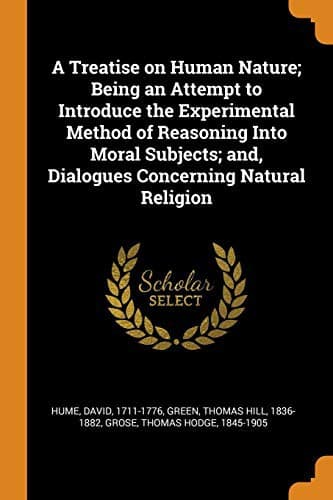
A Treatise of Human Nature: Being an Attempt to Introduce the Experimental Method Into Moral Subjects; and Dialogues Concerning Natural ReligionHume, David
PhilosophyPhilosophy
A Treatise of Human Nature: Being an Attempt to Introduce the Experimental Method Into Moral Subjects; and Dialogues Concerning Natural Religion
Hume, David
Emotions; Ethics; Knowledge, Theory of; Philosophy, English
329. It is constituted by relations, which are not impressions at
all; and in this lies explanation of the inference from it to ‘system
of judgment’.
330. Not seeing this, Hume has to explain inference to latter system
as something forced upon us by habit.
331. But if so, ‘system of judgment’ must consist of feelings
constantly experienced;
332. ... which only differ from remembered feelings inasmuch as their
liveliness has faded. But how can it have faded, if they have been
constantly repeated?
333. Inference then can give no new knowledge.
334. Nor does this merely mean that it cannot constitute new
phenomena, while it can prove relations, previously unknown, between
phenomena. Such a distinction inadmissible with Hume.
335. His distinction of probability of causes from that of chances
might seem to imply conception of nature, as determining inference.
336. But this distinction he only professes to adopt in order to
explain it away.
337. Laws of nature are unqualified habits of expectation.
338. Experience, according to his account of it, cannot be a parent
of knowledge.
339. His attitude towards doctrine of thinking substance.
340. As to Immateriality of the Soul, he plays off Locke and Berkeley
against each other, and proves Berkeley a Spinozist.
341. Causality of spirit treated in the same way.
342. Disposes of ‘personal’ identity by showing contradictions in
Locke’s account of it.
343. Yet can only account for it as a ‘fiction’ by supposing ideas
which with him are impossible.
344. In origin this ‘fiction’ the same as that of ‘Body’.
345. Possibility of such fictitious ideas implies refutation of
Hume’s doctrine.
SUMMARY OF THE CONTENTS
of the
GENERAL INTRODUCTION TO VOL. II.
1. Hume’s doctrine of morals parallel to his doctrine of nature.
2. Its relation to Locke: Locke’s account of freedom, will, and
desire.
3. Two questions: Does man always act from the strongest motive?
and, What constitutes his motive? The latter the important question.
Distinction between desires that are, and those that are not,
determined by the conception of self.
4. Effect of this conception on the objects of human desire.
5. Objects so constituted Locke should consistently exclude: But he
finds room for them by treating every desire for an object, of which
the attainment gives pleasure, as a desire for pleasure.
6. Confusion covered by calling ‘happiness’ the general object of
desire.
7. ‘Greatest sum of pleasure’ and ‘Pleasure in general’ unmeaning
expressions.
8. In what sense of happiness is it true that it ‘is really just as
it appears?’ In what sense that it is every one’s object?
9. No real object of human desire can ever be just as it appears.
10. Can Locke consistently allow the distinction between true
happiness and false? Or responsibility?
11. Objections to the Utilitarian answer to these questions.
Public-domain text, read in full here on John Shaqi.
Reviews
Reviews
No reviews yet
Be the first to share your thoughts on this work.
Join the Discussion
Join the discussion
Sign in to leave a comment or review.
Sign InorCreate an account