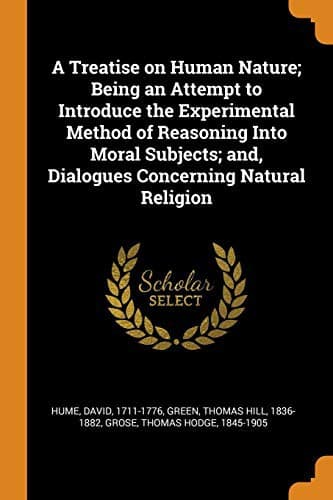
A Treatise of Human Nature: Being an Attempt to Introduce the Experimental Method Into Moral Subjects; and Dialogues Concerning Natural ReligionHume, David
PhilosophyPhilosophy
A Treatise of Human Nature: Being an Attempt to Introduce the Experimental Method Into Moral Subjects; and Dialogues Concerning Natural Religion
Hume, David
Emotions; Ethics; Knowledge, Theory of; Philosophy, English
123. To a reader, fresh from our popular treatises on Logic, such
language would probably at first present no difficulty. He would
merely lament that Locke, as a successor of Bacon, was not better
acquainted with the ‘Inductive methods,’ and thus did not understand
how an observation of co-existence in the bare instance, if the
instance be of the right sort, may warrant a universal affirmation.
Or he may take the other side, and regard Locke’s restriction upon
general certainty as conveying, not any doubt as to the validity
of the inference from an observed case to all cases where the
conditions are ascertainably the same, but a true sense of the
difficulty of ascertaining in any other case that the conditions
are the same. On looking closer, however, he will see that, so far
from Locke’s doctrine legitimately allowing of such an adaptation
to the exigencies of science, it is inconsistent with itself in
admitting the reality of most of the conditions in the case supposed
to be observed, and thus in allowing the real truth even of the
singular proposition. This purports to state, according to Locke’s
terminology, that certain ‘ideas’ do now or did once co-exist in a
body. But the ideas, thus stated to co-exist, according to Locke’s
doctrine that real existence is only testified to by actual present
sensation, differ from each other as that which _really_ exists
from that which does not. In the particular experiment of gold
being solved in aqua regia, from the complex idea of solubility an
indefinite deduction would have to be made for qualification by ideas
retained in the understanding before we could reach the present
sensation; and not only so, but the group of ideas indicated by
‘gold,’ to whose co-existence with solubility the experiment is said
to testify, as Locke himself says, form merely a nominal essence,
while the body to which we ascribe this essence is something which we
‘accustom ourselves to suppose,’ not any ‘parcel of matter’ having
a real existence in nature. [1] In asserting the co-existence of
the ideas forming such a nominal essence with the actual sensation
supposed to be given in the experiment, we change the meaning of
‘existence,’ between the beginning and end of the assertion, from
that according to which all ideas exist to that according to which
existence has no ‘connexion with any other of our ideas but those of
ourselves and God,’ but is testified to by present sensation. [2]
This paralogism escapes Locke just as his equivocal use of the term
‘idea’ escapes him. The distinction, fixed in Hume’s terminology as
that between impression and idea, forces itself upon him, as we have
seen, in the Fourth book of the Essay, where the whole doctrine of
real existence turns upon it, but alongside of it survives the notion
that ideas, though ‘in the mind’ and forming a nominal essence, are
yet, if rightly taken from things, ectypes of reality. Thus he does
not see that the co-existence of ideas, to which the particular
Public-domain text, read in full here on John Shaqi.
Reviews
Reviews
No reviews yet
Be the first to share your thoughts on this work.
Elsewhere in the archive
Join the Discussion
Join the discussion
Sign in to leave a comment or review.
Sign InorCreate an account