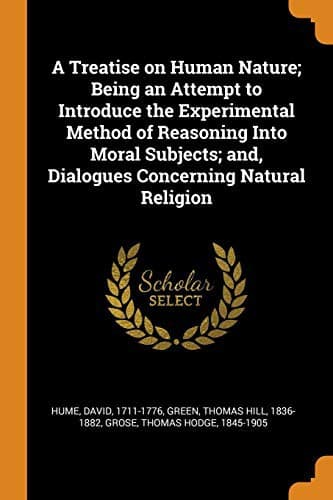
A Treatise of Human Nature: Being an Attempt to Introduce the Experimental Method Into Moral Subjects; and Dialogues Concerning Natural ReligionHume, David
PhilosophyPhilosophy
A Treatise of Human Nature: Being an Attempt to Introduce the Experimental Method Into Moral Subjects; and Dialogues Concerning Natural Religion
Hume, David
Emotions; Ethics; Knowledge, Theory of; Philosophy, English
experiment, as he describes it, testifies, is nothing else than the
co-existence of an event with a conception--of that which is in a
particular time, and (according to him) only for that reason real,
with that which is not in time at all but is an unreal abstraction
of the mind’s making. [3] The reality given in the actual sensation
cannot, as a matter of fact, be discovered to have a necessary
connexion with the ideas that form the nominal essence, and therefore
cannot be asserted universally to co-exist with them; but with better
faculties, he thinks, the discovery might be made (Book IV. chap.
iii. sec. 16). It does not to him imply such a contradiction as it
must have done if he had steadily kept in view his doctrine that of
particular (_i.e._ real) existence our ‘knowledge’ is not properly
knowledge at all, but simply sensation--such a contradiction as was
to Hume involved in the notion of deducing a matter of fact.
[1] See above, paragraphs 35, 94, &c.
[2] See above, paragraph 30 and the following.
[3] See above, paragraphs 45, 80, 85, 97.
With Locke mathematical truths, though ideal, true also of nature.
124. It results that those followers of Locke, who hold the
distinction between propositions of mathematical certainty and those
concerning real existence to be one rather of degree than of kind,
though they have the express words of their master against them, can
find much in his way of thinking on their side. This, however, does
not mean that he in any case drops the antithesis between matters of
fact and relations of ideas in favour of matters of fact, so as to
admit that mathematical propositions concern matters of fact, but
that he sometimes drops it in favour of relations of ideas, so as
to represent real existence as consisting in such relations. If the
matter of fact, or real existence, is to be found only in the event
constituted or reported by present feeling, such a relation of ideas,
by no manner of means reducible to an event, as the mathematical
proposition states, can have no sort of connection with it. But if
real existence is such that the relations of ideas, called primary
qualities of matter, constitute it, and the qualities included in our
nominal essences are its copies or effects, then, as on the one side
our complex ideas of substances only fail of reality through want of
fulness, or through mistakes in the process by which they are ‘taken
from things,’ so, on the other side, the mental truth of mathematical
propositions need only fail to be real because the ideas, whose
relations they state, are considered in abstraction from conditions
which qualify them in real existence. ‘If it is true of the idea of
a triangle that its three angles equal two right ones, it is true
also of a triangle, wherever it really exists’ (Book IV. chap. iv.
sec. 6). There is, then, no incompatibility between the idea and
real existence. Mathematical ideas might fairly be reckoned, like
Public-domain text, read in full here on John Shaqi.
Reviews
Reviews
No reviews yet
Be the first to share your thoughts on this work.
Elsewhere in the archive
Join the Discussion
Join the discussion
Sign in to leave a comment or review.
Sign InorCreate an account