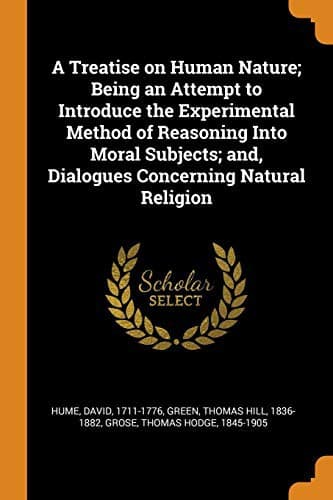
A Treatise of Human Nature: Being an Attempt to Introduce the Experimental Method Into Moral Subjects; and Dialogues Concerning Natural ReligionHume, David
PhilosophyPhilosophy
A Treatise of Human Nature: Being an Attempt to Introduce the Experimental Method Into Moral Subjects; and Dialogues Concerning Natural Religion
Hume, David
Emotions; Ethics; Knowledge, Theory of; Philosophy, English
those of substances, to be taken from real existence; but though,
like these, inadequate to its complexity, to be saved from the
necessary infirmities which attach to ideas of substances because not
considered as so taken, but merely as in the mind. There is language
about mathematics in Locke that may be interpreted in this direction,
though his most explicit statements are on the other side. It is not
our business to adjust them, but merely to point out the opposite
tendencies between which a clear-sighted operator on the material
given by Locke would find that he had to choose.
Two lines of thought in Locke, between which a follower would have to
choose.
125. On the one hand there is the identification of real existence
with the momentary sensible event. This view, of which the proper
result is the exclusion of predication concerning real existence
altogether, appears in Locke’s restriction of such predication to the
singular proposition, and in his converse assertion that propositions
of mathematical certainty ‘concern not existence’ (Book IV. chap.
iv. sec. 8). The embarrassment resulting from such a doctrine is
that it leads round to the admission of the originativeness of
thought and of the reality of its originations, with the denial of
which it starts. [1] It leads Locke himself along a track, which his
later followers scarcely seem to have noticed, when he treats the
‘never enough to be admired discoveries of Mr. Newton’ as having to
do merely with the relations of ideas in distinction from things,
and looks for a true extension of knowledge--neither in syllogism
which can yield no instructive, nor in experiment which can yield no
general, certainty--but only in a further process of ‘singling out
and laying in order intermediate ideas,’ which are ‘real as well as
nominal essences of their species,’ because they have no reference
to archetypes elsewhere than in the mind (Book IV. chap. vii. sec.
11, and Book IV. chap. xii. sec. 7). On the other hand there is the
notion that ideas, without distinction between ‘actual sensation’
and ‘idea in the mind,’ are taken from permanent things, and are
real if correctly so taken. From this it results that propositions,
universally true as representing a necessary relation between ideas
of primary qualities, are true also of real existence; and that an
extension of such real certainty through the discovery of a necessary
connexion between ideas of primary and those of secondary qualities,
though scarcely to be hoped for, has no inherent impossibility. It
is this notion, again, that unwittingly gives even that limited
significance to the particular experiment which Locke assigns to it,
as indicating a co-existence between ideas present as sensations
and those which can only be regarded as in the mind. Nor is it the
intrinsic import so much as the expression of this notion that is
altered when Locke substitutes an order of nature for substance
as that in which the ideas co-exist.
Public-domain text, read in full here on John Shaqi.
Reviews
Reviews
No reviews yet
Be the first to share your thoughts on this work.
Elsewhere in the archive
Join the Discussion
Join the discussion
Sign in to leave a comment or review.
Sign InorCreate an account