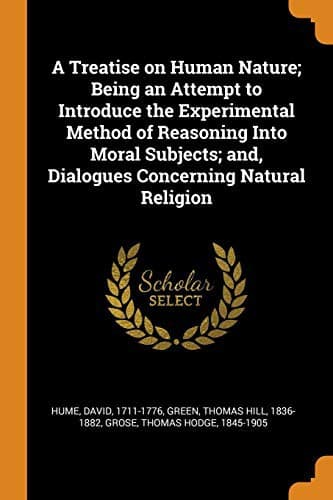
A Treatise of Human Nature: Being an Attempt to Introduce the Experimental Method Into Moral Subjects; and Dialogues Concerning Natural ReligionHume, David
PhilosophyPhilosophy
A Treatise of Human Nature: Being an Attempt to Introduce the Experimental Method Into Moral Subjects; and Dialogues Concerning Natural Religion
Hume, David
Emotions; Ethics; Knowledge, Theory of; Philosophy, English
[1] See above, paragraph 14.
[2] Book II., chap. i. sec. 23. ‘Sensation is such an impression
made in some part of the body, as produces some perception in the
understanding.’
[3] Locke speaks indifferently of the mind impressing the
understanding, and of the understanding impressing the mind, with
ideas of reflection, but as he specially defines ‘understanding’ as
the ‘perceptive power’ (Book II. chap. xxi. sec. 25.), I have written
as above.
[4] Cf. II. chap. i. secs. 11 and 14, with II. chap, xxvii. sec. 9.
It is difficult to see what ingenuity could reconcile the doctrine
stated in Book II. chap. xxvii. sec. 9, that personal identity is
identity of consciousness, with the doctrine implied in Book II.
chap. i. sec. 11, that the waking Socrates is the same person with
Socrates asleep, _i.e._ (according to Locke) not conscious at all.
Two ways out of such difficulties. ‘Matter’ and ‘mind’ have the same
source in self-consciousness.
132. In the history of subsequent philosophy two typical methods
have appeared of dealing with this chaos of antinomies. One, which
we shall have to treat at large in writing of Hume, affects to
dispose of both the outward and the inward synthesis--both of
the unity of feelings in a subject matter and of their unity in
a subject mind--as ‘fictions of thought.’ This method at once
suggests the vital question whether a mind which thus invents has
been effectively suppressed--whether, indeed, the theory can be so
much as stated without a covert assumption of that which it claims
to have destroyed. The other method, of which Kant is the parent,
does not attempt to efface the apparent contradictions which beset
the ‘relation between mind and matter;’ but regarding them as in
a certain sense inevitable, traces them to their source in the
application to the thinking Ego itself of conceptions, which it
does indeed constitute in virtue of its presence to phenomena given
under conditions of time, but under which for that very reason it
cannot itself be known. It is in virtue of the presence of the
self-conscious unit to the manifold of feeling, according to this
doctrine, that the latter becomes an order of definite things, each
external to the other; and it is only by a false inclusion within
this order of that which constitutes it that the Ego itself becomes
a ‘thinking thing’ with other things outside it. The result of such
inclusion is that the real world, which it in the proper sense makes,
becomes a reality external to it, yet apart from which it would
not be actually anything. Thus with Locke, though the mind has a
potential existence of its own, it is experience of ‘things without
it’ that ‘furnishes’ it or makes it what it actually is. But the
relation of such outer things to the mind cannot be spoken of without
contradiction. If supposed outward as bodies, they have to be brought
within consciousness as objects of sensation; if supposed outward
Public-domain text, read in full here on John Shaqi.
Reviews
Reviews
No reviews yet
Be the first to share your thoughts on this work.
Elsewhere in the archive
Join the Discussion
Join the discussion
Sign in to leave a comment or review.
Sign InorCreate an account