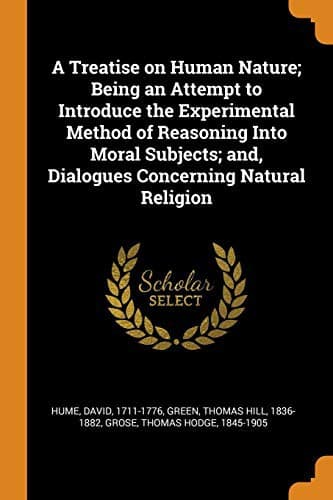
A Treatise of Human Nature: Being an Attempt to Introduce the Experimental Method Into Moral Subjects; and Dialogues Concerning Natural ReligionHume, David
PhilosophyPhilosophy
A Treatise of Human Nature: Being an Attempt to Introduce the Experimental Method Into Moral Subjects; and Dialogues Concerning Natural Religion
Hume, David
Emotions; Ethics; Knowledge, Theory of; Philosophy, English
as sensation, they have to be brought within consciousness--to find
a home in the understanding--as ideas of sensation. Meanwhile the
consideration returns that after all the ‘thinking thing’ contributes
something to that which it thinks about; and, this once admitted, it
is as impossible to limit its work on one side as that of the outer
thing on the other. Each usurps the place of its opposite. Thus with
Locke the understanding produces effects on itself, but the product
is one and the same ‘perception’ otherwise treated as an effect of
the outer world. One and the same self-consciousness, in short, [1]
involving the correlation of subject and object, becomes the result
of two separate ‘things,’ each exclusive of the other, into which the
opposite poles of this relation have been converted--the extended
thing or ‘body’ on the one side, and the thinking thing or ‘mind’ on
the other.
[1] For the equivalence of perception with self-consciousness in
Locke, see above, paragraph 24, et infra.
Difficulties in the way of ascribing reality to substance as matter,
re-appear in regard to substance as mind.
133. To each of these supposed ‘things’ thought transfers its own
unity and self-containedness, and thereupon finds itself in new
difficulties. These, so far as they concern the outward thing, have
already been sufficiently noticed. We have seen how the single
self-contained thing on the one hand attenuates itself to the bare
atom, presented in a moment of time, which in its exclusiveness
is actually nothing: [1] how, on the other, it spreads itself, as
everything which for one moment we regard as independent turns out
in the next to be a ‘retainer’ to something else, into a series that
cannot be summed. [2] A like consequence follows when the individual
man, conceiving of the thought, which is not mine but me, and which
is no less the world without which I am not I, as a thinking thing
within him, limited by the limitations of his animal nature, seeks
in this thinking thing, exclusive of other things, that unity and
self-containedness, which only belong to the universal ‘I.’ He
finds that he ‘thinks not always;’ that during a fourth part of his
time he neither thinks nor perceives at all; and that even in his
waking hours his consciousness consists of a succession of separate
feelings, whose recurrence he cannot command. [3] Thought being
thus broken and dependent, substantiality is not to be found in it.
It is next sought in the ‘thing’ of which thought is an occasional
operation--a thing of which it may readily be admitted that its
nature cannot be known (Book II. chap, xxiii. sec. 29, etc.), since
it has no nature, being merely that which remains of the thinking
thing upon abstraction of its sole determination. It is in principle
nothing else than the supposed basis of sensible qualities remaining
after these have been abstracted--the ‘parcel of matter’ which has
no essence--with which accordingly Locke sometimes himself tends
to identify it.
Public-domain text, read in full here on John Shaqi.
Reviews
Reviews
No reviews yet
Be the first to share your thoughts on this work.
Elsewhere in the archive
Join the Discussion
Join the discussion
Sign in to leave a comment or review.
Sign InorCreate an account