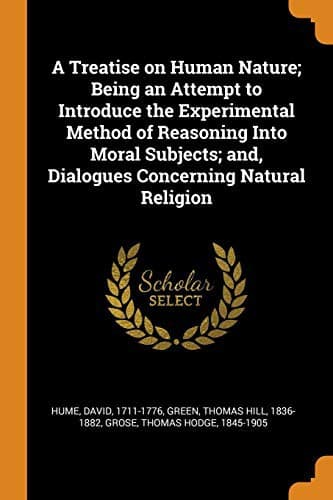
A Treatise of Human Nature: Being an Attempt to Introduce the Experimental Method Into Moral Subjects; and Dialogues Concerning Natural ReligionHume, David
PhilosophyPhilosophy
A Treatise of Human Nature: Being an Attempt to Introduce the Experimental Method Into Moral Subjects; and Dialogues Concerning Natural Religion
Hume, David
Emotions; Ethics; Knowledge, Theory of; Philosophy, English
136. The remark will at once occur that the question concerning the
relation between our consciousness, as in succession, and the idea
of God, is essentially different from that concerning the relation
between this consciousness and the self identical throughout it,
inasmuch as the relation in the one case is between a fact and an
idea, in the other between conflicting facts. The identity of the
self, which Locke asserts, is one of ‘real being,’ and this is
found to lie in consciousness, in apparent conflict with the fact
that consciousness is a succession, of which ‘no two parts exist
together.’ There is no such conflict, it will be said, between the
_idea_ of a conscious being, who is the same yesterday, to-day, and
for ever--the correspondence to which of any reality is a farther
question--and the _fact_ of our consciousness being in succession.
Allowing for the moment the validity of this distinction, we will
consider first the difficulties that attach to Locke’s account of the
idea of God, as an idea.
Locke’s account of this idea.
137. This idea, with him, is a ‘complex idea of substance.’ It is
the idea each man has of the ‘thinking thing within him, enlarged
to infinity.’ It is beset then in the first place with all the
difficulties which we have found to belong to his doctrine of
substance generally and of the thinking substance in particular.
[1] These need not be recalled in detail. When God is the thinking
substance they become more obvious. It is the antithesis to ‘material
substance,’ as the source of ideas of sensation, that alone with
Locke gives a meaning to ‘thinking substance,’ as the source of ideas
of reflection: and if, as we have seen, the antithesis is untenable
when it is merely the source of human ideas that is in question,
much more must it be so in regard to God, to whom any opposition
of material substance must be a limitation of his perfect nature.
Of the generic element in the above definition, then, no more need
here be said. It is the qualification of ‘enlargement to infinity,’
by which the idea of man as a thinking substance is represented as
becoming the idea of God, that is the special difficulty now before
us. Of this Locke writes as follows:--‘The complex idea we have
of God is made up of the simple ones we receive from reflection.
If I find that I know some few things, and some of them, or all
perhaps, imperfectly, I can frame an idea of knowing twice as many:
which I can double again as often as I can add to number, and thus
enlarge my ideas of knowledge by extending its comprehension to all
things existing or possible. The same I can do of knowing them more
perfectly, _i.e._ all their qualities, powers, causes, consequences,
and relations; and thus frame the idea of infinite or boundless
knowledge. The same also may be done of power till we come to that
we call infinite; and also of the duration of existence without
beginning or end; and so frame the idea of an eternal being. ...
Public-domain text, read in full here on John Shaqi.
Reviews
Reviews
No reviews yet
Be the first to share your thoughts on this work.
Elsewhere in the archive
Join the Discussion
Join the discussion
Sign in to leave a comment or review.
Sign InorCreate an account