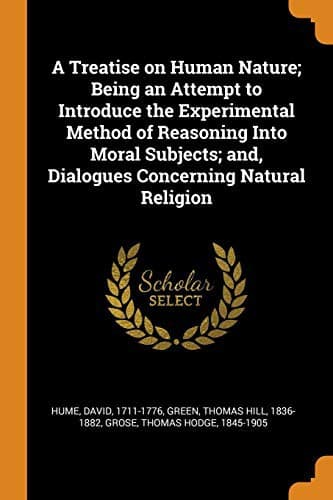
A Treatise of Human Nature: Being an Attempt to Introduce the Experimental Method Into Moral Subjects; and Dialogues Concerning Natural ReligionHume, David
PhilosophyPhilosophy
A Treatise of Human Nature: Being an Attempt to Introduce the Experimental Method Into Moral Subjects; and Dialogues Concerning Natural Religion
Hume, David
Emotions; Ethics; Knowledge, Theory of; Philosophy, English
dies, does not seem to have occurred to him. Taking for his method
the imaginary process of ‘looking into his own breast,’ instead
of the analysis of knowledge and morality, he could not find the
eternal self which knowledge and morality pre-suppose, but only the
contradiction of a person whose consciousness is not the same for two
moments together, and often ceases altogether, but who yet, in virtue
of an identity of this very consciousness, is the same in childhood
and in old age.
Locke neither disguises these contradictions, nor attempts to
overcome them.
135. Here as elsewhere we have to be thankful that the contradiction
had not been brought home so strongly to Locke as to make him
seek the suppression of either of its alternatives. He was aware
neither of the burden which his philosophy tended to put upon the
self which ‘can consider itself as itself in different times and
places’--the burden of replacing the stable world, when ‘the new way
of ideas’ should have resolved the outward thing into a succession of
feelings--nor of the hopelessness of such a burden being borne by a
‘perishing’ consciousness, ‘of which no two parts exist together, but
follow each other in succession.’ [1] When he ‘looked into himself,’
he found consciousness to consist in the succession of ideas,
‘one coming and another going:’ he also found that ‘consciousness
alone makes what we call self,’ and that he was the same self at
any different points in the succession. He noted the two ‘facts of
consciousness’ at different stages of his enquiry, and was apparently
not struck by their contradiction. He could describe them both, and
whatever he could describe seemed to him to be explained. Hence they
did not suggest to him any question either as to the nature of the
observed object or as to the possibility of observing it, such as
might have diverted philosophy from the method of self-observation.
He left them side by side, and, far from disguising either, put
alongside of them another fact--the presence among the perpetually
perishing ideas of that of a consciousness identical with itself, not
merely in different times and places, but in all times and places.
Such an idea, under the designation of an eternal wise Being, he was
‘sure he had’ (Book II. chap. xvii. sec. 14).
[1] Cf. Book II. chap. xiv. sec. 32--‘by observing what passes in our
minds, how our ideas there in train constantly some vanish and others
begin to appear, we come by the idea of succession; and by observing
a distance in the parts of this succession, we get the idea of
duration’--with chap. xv. sec. 12. ‘Duration is the idea we have of
perishing distance, of which no two parts exist together, but follow
each other in succession.’
Is the idea of God possible to a consciousness given in time?
Public-domain text, read in full here on John Shaqi.
Reviews
Reviews
No reviews yet
Be the first to share your thoughts on this work.
Elsewhere in the archive
Join the Discussion
Join the discussion
Sign in to leave a comment or review.
Sign InorCreate an account