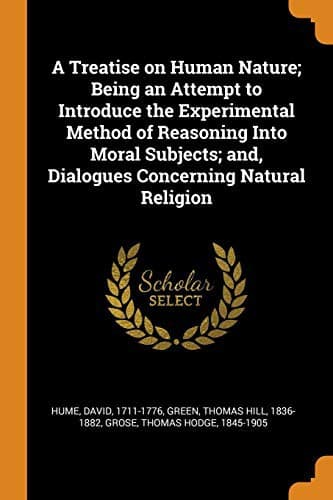
A Treatise of Human Nature: Being an Attempt to Introduce the Experimental Method Into Moral Subjects; and Dialogues Concerning Natural ReligionHume, David
PhilosophyPhilosophy
A Treatise of Human Nature: Being an Attempt to Introduce the Experimental Method Into Moral Subjects; and Dialogues Concerning Natural Religion
Hume, David
Emotions; Ethics; Knowledge, Theory of; Philosophy, English
147. Our knowledge of God’s existence, according to him, is
‘demonstrative,’ based on the ‘intuitive’ knowledge of our own.
Strictly taken, according to his definitions, this must mean that the
agreement of the idea of God with existence is perceived mediately
through the agreement of the idea of self with existence, which is
perceived immediately; that thus the idea of God and the idea of
self ‘agree’. [1] We need not, however, further dwell either on
the contradiction implied in the knowledge of real existence, if
knowledge is a perception of agreement between ideas and if real
existence is the antithesis of ideas; or on the embarrassments which
follow when a definition of reasoning, only really applicable to the
comparison of quantities, is extended to other regions of knowledge.
Locke virtually ignores his definitions in the passage before us. ‘If
we know there is some real being’ (as we do know in the knowledge
of our own existence) ‘and that non-entity cannot produce any real
being, it is an evident demonstration that from eternity there has
been something; since what was not from eternity had a beginning,
and what had a beginning must be produced by something else’ (Book
IV. chap. x. sec. 3). Next as to the qualities of this something
else. ‘What had its being and beginning from another must also have
all that which is in, and belongs to, its being from another too’
(Ibid, sec. 4.). From this is deduced the supreme power and perfect
knowledge of the eternal being upon the principle that whatever is in
the effect must also be in the cause--a principle, however, which has
to be subjected to awkward limitations in order that, while proving
enough, it may not prove too much, it might seem that, according to
it, since the real being, from which as effect the eternal being as
cause is demonstrated, is ‘both material and cogitative’ or ‘made up
of body and spirit,’ matter as well as thought must belong to the
eternal being too. That thought must belong to him, Locke is quite
clear. It is as impossible, he holds, that thought should be derived
from matter, or from matter and motion together, as that something
should be derived from nothing. ‘If we will suppose nothing first
or eternal, matter can never begin to be: if we suppose bare matter
without motion eternal, motion can never begin to be: if we suppose
only matter and motion first or eternal, thought can never begin
to be’ (Book IV. chap. x. sec. 10). The objection which is sure to
occur, that it must be equally impossible for matter to be derived
from thought, he can scarcely be said to face. He takes refuge in the
supreme power of the eternal being, as that which is able to create
matter out of nothing. He does not anticipate the rejoinder to which
he thus lays himself open, that this power in the eternal being to
produce one effect not homogeneous with itself, viz. matter, may
extend to another effect, viz. thought, and that thus the argument
Public-domain text, read in full here on John Shaqi.
Reviews
Reviews
No reviews yet
Be the first to share your thoughts on this work.
Elsewhere in the archive
Join the Discussion
Join the discussion
Sign in to leave a comment or review.
Sign InorCreate an account