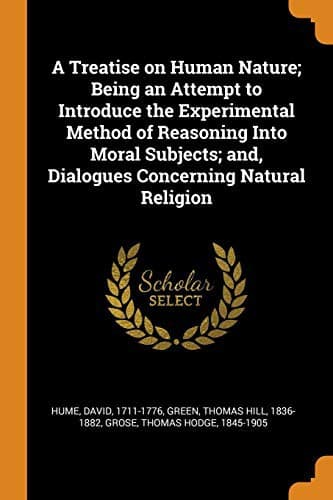
A Treatise of Human Nature: Being an Attempt to Introduce the Experimental Method Into Moral Subjects; and Dialogues Concerning Natural ReligionHume, David
PhilosophyPhilosophy
A Treatise of Human Nature: Being an Attempt to Introduce the Experimental Method Into Moral Subjects; and Dialogues Concerning Natural Religion
Hume, David
Emotions; Ethics; Knowledge, Theory of; Philosophy, English
from thought in the effect to thought in the cause becomes invalid,
and nothing but blind power, we know not what, remains as the
attribute of the eternal being. Nor does he remember, when he meets
the objection drawn from the inconceivability of matter being made
out of nothing by saying that what is inconceivable is not therefore
impossible (_ibid_. sec. 19), that it is simply the inconceivability
of a sequence of something upon nothing that has given him his
‘evident demonstration’ of an eternal being.
[1] See above, paragraphs 25 and 24.
How ‘eternity’ must be understood if this argument is to be valid:
148. The value of the first step in Locke’s argument--the inference,
namely, from there being something now to there having been something
from eternity--must be differently estimated according to the meaning
attached to ‘something’ and ‘from eternity.’ If the existence of
something means the occurrence of an event, of this undoubtedly
it can always be said that it follows another event, nor to this
sequence can any limit be supposed, for a first event would not be
an event at all. It would be a contingency contingent upon nothing.
Thus understood, the argument from a something now to a something
from eternity is merely a statement of the infinity of time according
to that notion of infinity, as a ‘progressus ad indefinitum,’ which
we have already seen to be Locke’s. [1] It is the exact reverse of
an argument to a creation or a first cause. If we try to change
its character by a supplementary consideration that infinity in
the series of events is inconceivable, the rejoinder will be that
a first event is not for that reason any less of a contradiction,
and that the infinity which Locke speaks of only professes to be a
negative idea, representing the impossibility of conceiving a first
event (Book II. chap. xvii. sec. 13, &c.). In truth, however, when
Locke speaks of ‘something from eternity’ he does not mean--what
would clearly be no God at all--a series of events to which, because
_of events_, and therefore in time, no limit can be supposed; but a
being which is neither event nor series of events, to which there is
no before or after. The inference to such a being is not of a kind
with the transition from one event to another habitually associated
with it; and if this be the true account of reasoning from effect to
cause, no such reasoning can yield the result which Locke requires.
As we have seen, however, this is not his account of it, [2] however
legitimately it may follow from his general doctrine.
[1] See above, paragraph 138.
[2] See above, paragraph 68.
... and how ‘cause’.
Public-domain text, read in full here on John Shaqi.
Reviews
Reviews
No reviews yet
Be the first to share your thoughts on this work.
Elsewhere in the archive
Join the Discussion
Join the discussion
Sign in to leave a comment or review.
Sign InorCreate an account