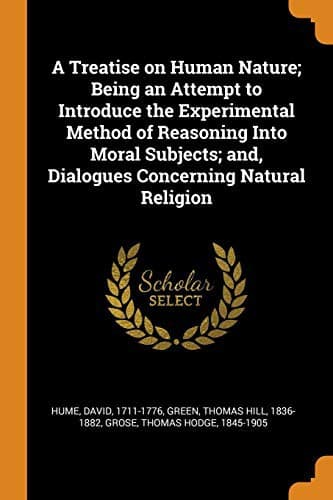
A Treatise of Human Nature: Being an Attempt to Introduce the Experimental Method Into Moral Subjects; and Dialogues Concerning Natural ReligionHume, David
PhilosophyPhilosophy
A Treatise of Human Nature: Being an Attempt to Introduce the Experimental Method Into Moral Subjects; and Dialogues Concerning Natural Religion
Hume, David
Emotions; Ethics; Knowledge, Theory of; Philosophy, English
contingencies by relation to what is not contingent; he must suppose
nature unchanging, though our experience of it through sensation
be a ‘progressus ad indefinitum’--if he is to allow a possibility
of knowledge at all. In short, if events were merely events,
feelings that happen to me now and next moment are over, no ‘law
of causation’ and therefore no knowledge would be possible. If the
knowledge founded on this law actually exists, then the ‘argumentum
a contingentiâ mundi’ rightly understood--the ‘inference’ from
nature to a being neither in time nor contingent but self-dependent
and eternal, that constant reality of which events are the changing
appearances--is valid because the conception of nature, of a
world to be known, already implies such a being. To the rejoinder
that implication in the conception of nature does not prove real
existence, the answer must be the question. What meaning has real
existence, the antithesis of illusion, except such as is equivalent
to this conception?
[1] cf. Book II. chap. xxvi. sec. 1, and chap. xxi. sec. 1.
The world which is to prove an eternal God must be itself eternal.
150. The value, then, of Locke’s demonstration of the existence of
God, as an argument from there being something now to an eternal
being from which the real existence that we know ‘has all which is in
and belongs to it,’ depends on our converting it into the ‘argumentum
a contingentiâ mundi,’ stated as above. In other words, it depends on
our interpreting it in a manner which may be warranted by his rough
account of causation, and by one of the incompatible views of the
real that we have found in him, [1] but which is inconsistent with
his opposition of reality to the work of the mind, and his reduction
of it to ‘particular existence,’ as well as with his ordinary view
that ‘infinite’ and ‘eternal’ can represent only a ‘progressus ad
indefinitum.’ If by ‘real existence corresponding to an idea’ is
meant its presentation in a particular ‘here and now,’ an attempt
to find a real existence of God can bring us to nothing but such a
contradiction in terms as a first event. To prove it from the real
existence of the self is to prove one impossibility from another.
If, on the other hand, real existence implies the determination
of our ideas by an order of nature--if it means ideas ‘in ordine
ad universum’ (to use a Baconian phrase), in distinction from ‘in
ordine ad nos’--then the argument from a present to an eternal real
existence is valid, but simply in the sense that the present is
already real, and ‘has all that is in and belongs to it,’ only in
virtue of the relation to the eternal.
[1] See above, paragraphs 49 and 91.
But will the God, whose existence is so proven, be a thinking being?
Public-domain text, read in full here on John Shaqi.
Reviews
Reviews
No reviews yet
Be the first to share your thoughts on this work.
Elsewhere in the archive
Join the Discussion
Join the discussion
Sign in to leave a comment or review.
Sign InorCreate an account