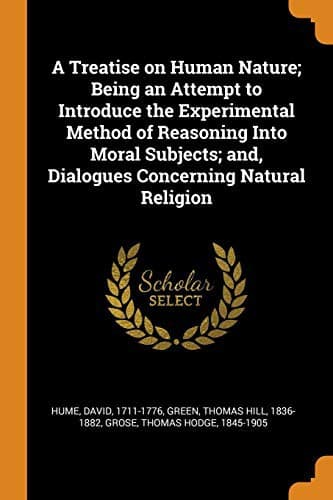
A Treatise of Human Nature: Being an Attempt to Introduce the Experimental Method Into Moral Subjects; and Dialogues Concerning Natural ReligionHume, David
PhilosophyPhilosophy
A Treatise of Human Nature: Being an Attempt to Introduce the Experimental Method Into Moral Subjects; and Dialogues Concerning Natural Religion
Hume, David
Emotions; Ethics; Knowledge, Theory of; Philosophy, English
149. The inference of cause with him is the inference from a change
to something having power to produce it. [1] The value of this
definition lies not in the notion of efficient power, but in that
of an order of nature, which it involves. If instead of ‘something
having power to produce it’ we read ‘something that accounts for the
change,’ it expresses the inference on which all science rests, but
which is as far as possible from being merely a transition from one
event to another that usually precedes it. An event, interpreted as
a change of something that remains constant, is no longer a mere
event. It is no longer merely in time, a present which next moment
becomes a past. It takes its character from relation to the thing or
system of things of which it is an altered appearance, but which in
itself is always the same. Only in virtue of such a relation does it
require to be accounted for, to be referred to a ‘cause’ which is in
truth the conception that holds together or reconciles the endless
flux of events with eternal unity. The cause of a ‘phenomenon,’ even
according to the authoritative exponent of the Logic which believes
itself to follow Hume, is the ‘sum total of its conditions.’ In its
fulness, that is, it is simply that system of things, conceived
explicitly, of which there must already have been an implicit
conception in order that the event might be regarded as a change
and thus start the search for a cause. An event in time, apart from
reference to something not in time, could suggest no enquiry into
the sum of its conditions. Upon occurrence of a certain feeling
there might indeed be spontaneous recollection of a feeling usually
precedent, spontaneous expectation of another usually sequent. But
such association of feelings can never explain that conception of
cause in virtue of which, when accounting for a phenomenon, we set
aside the event which in our actual experience has usually preceded
it, for one which we only find to precede it in the single case of
a crucial experiment. That we do so shows that it is not because of
antecedence in time, however apparently uniform, that an educated man
reckons a certain event to be the cause of another, but that, because
of its sole sufficiency under the sum of known conditions to account
for the given event, he decides it to be its uniform antecedent,
however much ordinary appearances may tell to the contrary. Thus,
though he may still strangely define cause as a uniformly antecedent
event (in spite of its being a definition that would prevent him
from speaking of gravity as the cause of the fall of a stone), it
is clear that by such event he means one determined by a complex of
conditions in an unchanging universe. These conditions, again, he may
speak of as contingencies, _i.e._ as events contingent upon other
events in endless series, but he must add ‘contingent in accordance
with the uniformity of nature’--in other words, he must determine the
Public-domain text, read in full here on John Shaqi.
Reviews
Reviews
No reviews yet
Be the first to share your thoughts on this work.
Elsewhere in the archive
Join the Discussion
Join the discussion
Sign in to leave a comment or review.
Sign InorCreate an account