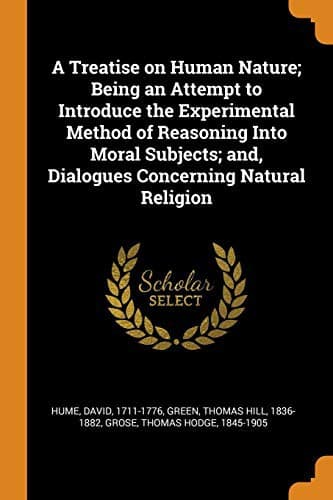
A Treatise of Human Nature: Being an Attempt to Introduce the Experimental Method Into Moral Subjects; and Dialogues Concerning Natural ReligionHume, David
PhilosophyPhilosophy
A Treatise of Human Nature: Being an Attempt to Introduce the Experimental Method Into Moral Subjects; and Dialogues Concerning Natural Religion
Hume, David
Emotions; Ethics; Knowledge, Theory of; Philosophy, English
a renewed confusion of the relation between thought and its object
with that between body and body, qualities, which are credited with
a primary reality as independent of and antithetical to the mind,
are brought within it again as ideas. They are supposed to copy
themselves upon it by impact and impression; and that not in touch
merely, but (visual feelings being interpreted by help of the same
conception) in sight also.
Two ways of dealing with it. Berkeley chooses the most obvious.
158. Such ‘materialism’ invites two different methods of attack.
On the one hand its recognised principle, that all intellectual
‘superinduction’ upon simple feeling is a departure from the real,
may be insisted on, and it may be shown that it is only by such
superinduction that simple feeling becomes a feeling of body. Matter,
then, with all its qualities, is a fiction except so far as these
can be reduced to simple feelings. Such in substance was Berkeley’s
short method with the materialists. In his early life it seemed
to him sufficient for the purposes of orthodox ‘spiritualism,’
because, having posed the materialist, he took the moral and
spiritual attributes of God as ‘revealed,’ without enquiring into the
possibility of such revelation to a merely sensitive consciousness.
As he advanced, other questions, fatal to the constructive value of
his original method, began to force themselves upon him. Granting
that intellectual superinduction = fiction, how is the fiction
possible to a mind which cannot originate? Exclude from reality all
that such fiction constitutes, and what remains to be real? These
questions, however, though their effect on his mind appears in the
later sections of his ‘Siris,’ he never systematically pursued. He
thus missed the true method of attack on materialism--the only one
that does not build again that which it destroys--the method which
allows that matter is real but only so in virtue of that intellectual
superinduction upon feeling without which there could be for us no
reality at all: that thus it is indeed opposed to thought, but only
by a position which is thought’s own act. For the development of
such views Berkeley had not patience in his youth nor leisure in his
middle life. Whatever he may have suggested, all that he logically
achieved was an exposure of the equivocation between feeling and felt
body; and of this the next result, as appears in Hume, was a doctrine
which indeed delivers mind from dependence on matter, but only by
reducing it in effect to a succession of feelings which cannot know
themselves.
His account of the relation between visible and tangible extension.
We do not see bodies without the mind ...
Public-domain text, read in full here on John Shaqi.
Reviews
Reviews
No reviews yet
Be the first to share your thoughts on this work.
Elsewhere in the archive
Join the Discussion
Join the discussion
Sign in to leave a comment or review.
Sign InorCreate an account