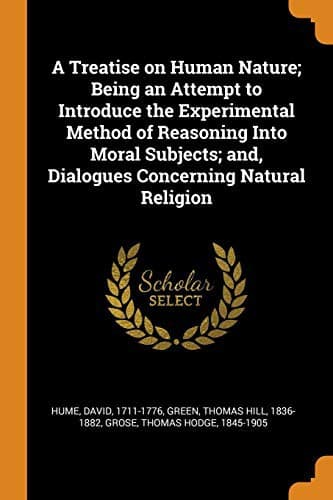
A Treatise of Human Nature: Being an Attempt to Introduce the Experimental Method Into Moral Subjects; and Dialogues Concerning Natural ReligionHume, David
PhilosophyPhilosophy
A Treatise of Human Nature: Being an Attempt to Introduce the Experimental Method Into Moral Subjects; and Dialogues Concerning Natural Religion
Hume, David
Emotions; Ethics; Knowledge, Theory of; Philosophy, English
159. It was upon the extension of the metaphor of impression to
sight as well as touch, and the consequent notion that body, with
its inseparable qualities, revealed itself through both senses,
that Berkeley first fastened. Is it evident, as Locke supposed it
to be, that men ‘perceive by their sight’ not colours merely, but
‘a distance between bodies of different colours and between parts
of the same body’; [1] in other words, situation and magnitude? To
show that they do not is the purpose of Berkeley’s ‘Essay towards a
new Theory of Vision.’ He starts from two principles which he takes
as recognised: one, that the ‘proper and immediate object of sight
is colour’; the other, that distance from the eye, or distance in
the line of vision, is not immediately seen. If, then, situation and
magnitude are ‘properly and immediately’ seen, they must be qualities
of colour. Now in one sense, according to Berkeley, they are so: in
other words, there is such a thing as _visible_ extension. We see
lights and colours in ‘sundry situations’ as well as ‘in degrees
of faintness and clearness, confusion and distinctness.’ (_Theory
of Vision_, sec. 77.) We also see objects as made up of certain
‘quantities of coloured points,’ _i.e._ as having visible magnitude.
(Ibid. sec. 54.) But situation and magnitude _as visible_ are not
external, not ‘qualities of body,’ nor do they represent by any
_necessary_ connection the situation and magnitude that are truly
qualities of body, the mind, ‘without the mind and at a distance.’
These are tangible. Distance in all its forms--as distance from the
eye; as distance between parts of the same body, or magnitude; and
as distance of body from body, or situation--is tangible. What a man
means when he says that ‘he sees this or that thing at a distance’ is
that ‘what he sees suggests to his understanding that after having
passed a certain distance, to be measured by the motion of his body
which is perceivable by touch, he shall come to perceive such and
such tangible ideas which have been usually connected with such and
such visible ideas’ (Ibid. sec. 45). On the same principle we are
said to see the magnitude and situation of bodies. Owing to long
experience of the connection of these tangible ideas with visible
ones, the magnitude of the latter and their degrees of faintness and
clearness, of confusion and distinctness, enable us to form a ‘sudden
and true’ estimate of the magnitude of the former (_i.e._ of bodies);
even as visible situation enables us to form a like estimate of the
‘situation of things outward and tangible’ (Ibid. secs. 56 and 99).
The connection, however, between the two sets of ideas, Berkeley
insists, is habitual only, not necessary. As Hume afterwards said of
the relation of cause and effect, it is not constituted by the nature
of the ideas related. [2] The visible ideas, that as a matter of fact
‘suggest to us the various magnitudes of external objects before we
Public-domain text, read in full here on John Shaqi.
Reviews
Reviews
No reviews yet
Be the first to share your thoughts on this work.
Elsewhere in the archive
Join the Discussion
Join the discussion
Sign in to leave a comment or review.
Sign InorCreate an account