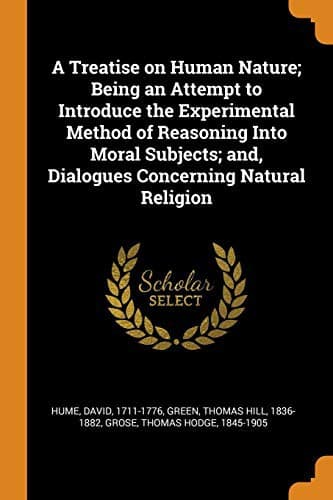
A Treatise of Human Nature: Being an Attempt to Introduce the Experimental Method Into Moral Subjects; and Dialogues Concerning Natural ReligionHume, David
PhilosophyPhilosophy
A Treatise of Human Nature: Being an Attempt to Introduce the Experimental Method Into Moral Subjects; and Dialogues Concerning Natural Religion
Hume, David
Emotions; Ethics; Knowledge, Theory of; Philosophy, English
Hume differed from the system-making for purposes of edification to
which Leibnitz applied himself. It has been unprofitable, because
its representatives have persisted in philosophising upon principles
which Hume had pursued to their legitimate issue and had shown,
not as their enemy but as their advocate, to render all philosophy
futile. Adopting the premises and method of Locke, he cleared them of
all illogical adaptations to popular belief, and experimented with
them on the body of professed knowledge, as one only could do who
had neither any twist of vice nor any bias for doing good, but was a
philosopher because he could not help it.
Kant his true successor.
3. As the result of the experiment, the method, which began with
professing to explain knowledge, showed knowledge to be impossible.
Hume himself was perfectly cognisant of this result, but his
successors in England and Scotland would seem so far to have been
unable to look it in the face. They have either thrust their
heads again into the bush of uncriticised belief, or they have
gone on elaborating Hume’s doctrine of association, in apparent
forgetfulness of Hume’s own proof of its insufficiency to account
for an intelligent, as opposed to a merely instinctive or habitual,
experience. An enquiry, however, so thorough and passionless as the
‘Treatise of Human Nature,’ could not be in vain; and if no English
athlete had strength to carry on the torch, it was transferred to a
more vigorous line in Germany. It awoke Kant, as he used to say, from
his ‘dogmatic slumber,’ to put him into that state of mind by some
called wonder, by others doubt, in which all true philosophy begins.
This state, with less ambiguity of terms, may be described as that of
freedom from presuppositions. It was because Kant, reading Hume with
the eyes of Leibnitz and Leibnitz with the eyes of Hume, was able to
a great extent to rid himself of the presuppositions of both, that he
started that new method of philosophy which, as elaborated by Hegel,
claims to set man free from the artificial impotence of his own false
logic, and thus qualify him for a complete interpretation of his own
achievement in knowledge and morality. Thus the ‘Treatise of Human
Nature’ and the ‘Critic of Pure Reason,’ taken together, form the
real bridge between the old world of philosophy and the new. They are
the essential ‘Propaedeutik,’ without which no one is a qualified
student of modern philosophy. The close correspondence between the
two works becomes more apparent the more each is studied. It is
such as to give a strong presumption that Kant had studied Hume’s
doctrine in its original and complete expression, and not merely as
it was made easy in the ‘Essays.’ The one with full and reasoned
articulation asks the question, which the other with equal fulness
seeks to answer. It is probably because the question in its complete
statement has been so little studied among us, that the intellectual
Public-domain text, read in full here on John Shaqi.
Reviews
Reviews
No reviews yet
Be the first to share your thoughts on this work.
Join the Discussion
Join the discussion
Sign in to leave a comment or review.
Sign InorCreate an account