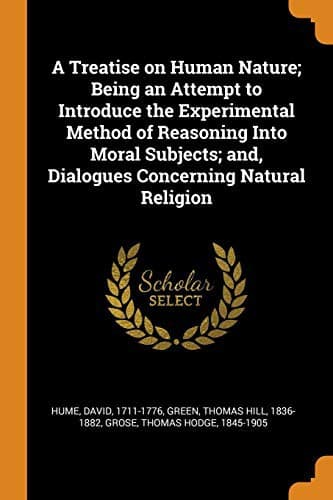
A Treatise of Human Nature: Being an Attempt to Introduce the Experimental Method Into Moral Subjects; and Dialogues Concerning Natural ReligionHume, David
PhilosophyPhilosophy
A Treatise of Human Nature: Being an Attempt to Introduce the Experimental Method Into Moral Subjects; and Dialogues Concerning Natural Religion
Hume, David
Emotions; Ethics; Knowledge, Theory of; Philosophy, English
172. Even those least disposed to ‘vanquish Berkeley with a grin’
have found his doctrine of the real, which is also his doctrine of
God, ‘unsatisfactory.’ By the real world they are accustomed to
understand something which--at least in respect of its ‘elements’
or ‘conditions’ or ‘laws’--permanently is; though the combinations
of the elements, the events which flow from the conditions, the
manifestations of the laws, may never be at one time what they
will be at the next. But according to the Berkeleian doctrine the
permanent seems to disappear: the ‘is’ gives place to a ‘has been’
and ‘will be.’ If I say (δεικτικῶς) [1] ‘there is a body,’ I must
mean according to it that a feeling has just occurred to me, which
has been so constantly followed by certain other feelings that it
suggests a lively expectation of these. The suggestive feeling
alone _is_, and it is ceasing to be. If this is the true account of
propositions suggested by everyone’s constantly-recurrent experience,
what are we to make of scientific truths, _e.g._ ‘a body will change
its place sooner than let another enter it,’ ‘planets move in
ellipses,’ ‘the square on the hypotheneuse is equal to the squares on
the sides.’ In these cases, too, does the present reality lie merely
in a feeling experienced by this or that scientific man, and to him
suggestive of other feelings? Does the proposition that ‘planets move
in ellipses’ mean that to some watcher of the skies, who understands
Kepler’s laws, a certain perception of ‘visible extension’ (_i.e._
of colour or light and shade) not only suggests, as to others, a
particular expectation of other feelings, which expectation is called
a planet, but a further expectation, not shared by the multitude, of
feelings suggesting successive situations of the visible extension,
which further expectation is called elliptical motion? Such an
explanation of general propositions would be a form of the doctrine
conveniently named after Protagoras--‘ἀληθὲς ὃ ἑκάστῳ ἑκάστοτε δοκεῖ’
[2]--a doctrine which the vindicators of Berkeley are careful to
tell us we must not confound with his. The question, however, is not
whether Berkeley himself admits the doctrine, but whether or no it is
the logical consequence of the method which he uses for the overthrow
of materialists and ‘mathematical Atheists’?
[1] [Greek δεικτικῶς (deiktikos) = “affirmatively” or “capable of
being proven” _i.e._ not merely hypothetically. Tr.]
[2] [Greek ἀληθὲς ὃ ἑκάστῳ ἑκάστοτε δοκεῖ (alethes ho hekasto
hekastote dokei) = the truth for each man is as it appears to him.
Tr.]
Berkeley goes wrong from confusion between thought and feeling. For
Locke’s ‘idea of a thing’ he substitutes ‘idea’ simply.
Public-domain text, read in full here on John Shaqi.
Reviews
Reviews
No reviews yet
Be the first to share your thoughts on this work.
Elsewhere in the archive
Join the Discussion
Join the discussion
Sign in to leave a comment or review.
Sign InorCreate an account