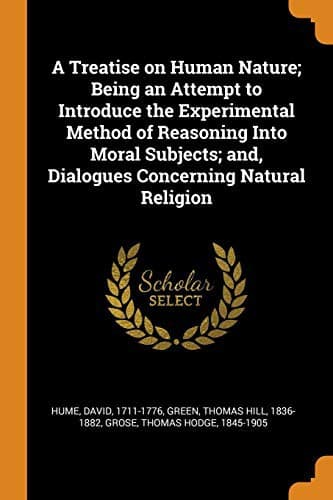
A Treatise of Human Nature: Being an Attempt to Introduce the Experimental Method Into Moral Subjects; and Dialogues Concerning Natural ReligionHume, David
PhilosophyPhilosophy
A Treatise of Human Nature: Being an Attempt to Introduce the Experimental Method Into Moral Subjects; and Dialogues Concerning Natural Religion
Hume, David
Emotions; Ethics; Knowledge, Theory of; Philosophy, English
173. His purpose was the maintenance of Theism, and a true instinct
told him that pure Theism, as distinct from nature-worship and
daemonism, has no philosophical foundation, unless it can be shown
that there is nothing real apart from thought. But in the hurry
of theological advocacy, and under the influence of a misleading
terminology, he failed to distinguish this true proposition--there
is nothing real apart from thought--from this false one, its virtual
contradictory--there is nothing other than feeling. The confusion
was covered, if not caused, by the ambiguity, often noticed, in
the use of the term ‘idea.’ This to Berkeley’s generation stood
alike for feeling proper, which to the subject that merely feels
is neither outer nor inner, because not referring itself to either
mind or thing, and for conception, or an object thought of under
relations. According to Locke, pain, colour, solidity, are all ideas
equally with each other and equally with the _idea of_ pain, _idea
of_ colour, _idea of_ solidity. If all alike, however, were feelings
proper, there would be no world either to exist or be spoken of.
Locke virtually saves it by two suppositions, each incompatible with
the equivalence of idea to feeling, and implying the conversion of
it into conception as above defined. One is that there are abstract
ideas; the other that there are primary qualities of which ideas
are copies, but which do not come and go with our feelings. The
latter supposition gives a world that ‘really exists,’ the former
a world that may be known and spoken of; but neither can maintain
itself without a theory of conception which is not forthcoming in
Locke himself. We need not traverse again the contradictions which
according to his statement they involve--contradictions which, under
whatever disguise, must attach to every philosophy that admits a
reality either in things as apart from thought or in thought as apart
from things, and only disappear when the thing as thought of, and
through thought individualised by the relations which constitute
its community with the universe, is recognised as alone the real.
Misled by the phrase ‘idea of a thing,’ we fancy that idea and thing
have each a separate reality of their own, and then puzzle ourselves
with questions as to how the idea can represent the thing--how the
ideas of primary qualities can be copies of them, and how, if the
real thing of experience be merely individual, a general idea can
be abstracted from it. These questions Berkeley asked and found
unanswerable. There were then two ways of dealing with them before
him. One was to supersede them by a truer view of thought and its
object, as together in essential correlation constituting the real;
but this way he did not take. The other was to avoid them by merging
both thing and idea in the indifference of simple feeling. For a
merely sentient being, it is true--for one who did not think upon
his feelings--the oppositions of inner and outer, of subjective
Public-domain text, read in full here on John Shaqi.
Reviews
Reviews
No reviews yet
Be the first to share your thoughts on this work.
Elsewhere in the archive
Join the Discussion
Join the discussion
Sign in to leave a comment or review.
Sign InorCreate an account