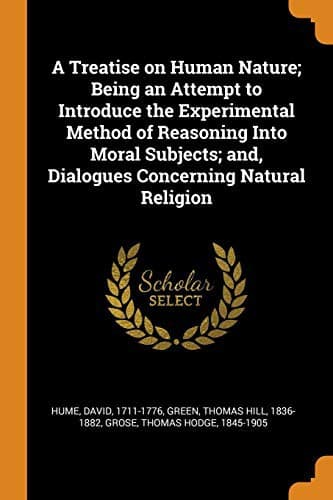
A Treatise of Human Nature: Being an Attempt to Introduce the Experimental Method Into Moral Subjects; and Dialogues Concerning Natural ReligionHume, David
PhilosophyPhilosophy
A Treatise of Human Nature: Being an Attempt to Introduce the Experimental Method Into Moral Subjects; and Dialogues Concerning Natural Religion
Hume, David
Emotions; Ethics; Knowledge, Theory of; Philosophy, English
180. As with vacuum, so with infinite divisibility. Once let it
be understood that extension is constituted by the relation of
externality between homogeneous parts, and it follows that there can
be no _least_ part of extension, none that does not itself consist
of parts; in other words, that it is infinitely divisible: just as
conversely it follows that there can be no _last_ part of it, not
having another outside it; in other words, that (to use Locke’s
phrase) it is infinitely addible. Doubtless, as Berkeley held, there
is a ‘minimum visibile’; but this means that there are conditions
under which any seen colour disappears, and disappearing, ceases to
be known under the relation of extension; but it is only through a
confusion of the relation with the colour that the disappearance of
the latter is thought to be a disappearance of so much extension. [1]
It was, in short, the same failure to recognise the true ideality of
space, as a relation constituted by thought, that on the one hand
made its ‘purity’ and infinity unmeaning to Berkeley, and on the
other made him think that, if pure (_sc_. irreducible to feelings)
and infinite, it must limit the Divine perfection, either as being
itself God or as ‘something beside God which is eternal, uncreated,
and infinite’ (‘Principles of Human Knowledge,’ sec. 117). Fear of
this result set him upon that method of resolving space, and with it
the world of nature, into sequent feelings, which, if it had been
really susceptible of logical expression, would at best have given
him nothing but a μέγα ζῶον [2] for God. If he had been in less of
a hurry with his philosophy, he might have found that the current
tendency to ‘bind God in nature or diffuse in space’ required to be
met by a sounder than his boyish idealism--by an idealism which gives
space its due, but reflects that to make space God, or a limitation
on God, is to subject thought itself to the most superficial of the
relations by which it forms the world that it knows.
[1] The same remark of course applies, _mutatis mutandis_, to the
‘minimum tangibile.’ See below, paragraphs 265 and 260.
[2] [Greek μέγα ζῶον (mega zoon) = great being. Tr.]
How he deals with possibility of general knowledge.
Public-domain text, read in full here on John Shaqi.
Reviews
Reviews
No reviews yet
Be the first to share your thoughts on this work.
Elsewhere in the archive
Join the Discussion
Join the discussion
Sign in to leave a comment or review.
Sign InorCreate an account