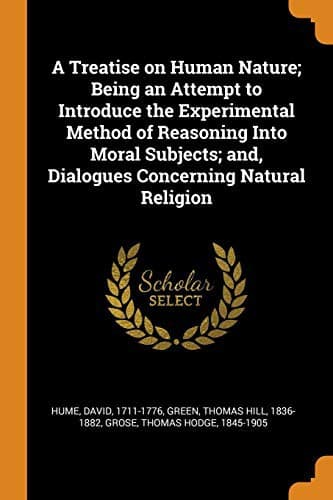
A Treatise of Human Nature: Being an Attempt to Introduce the Experimental Method Into Moral Subjects; and Dialogues Concerning Natural ReligionHume, David
PhilosophyPhilosophy
A Treatise of Human Nature: Being an Attempt to Introduce the Experimental Method Into Moral Subjects; and Dialogues Concerning Natural Religion
Hume, David
Emotions; Ethics; Knowledge, Theory of; Philosophy, English
179. Of this result he himself shows no suspicion. He professes to
be able, without violence to his doctrine, to accept the sciences
as they stand, except so far as they rest upon the needless and
unmeaning assumptions (as he reckoned them) of _pure_ space and its
infinite divisibility. The truth seems to be that--at any rate in
the state of mind represented his earlier treatises--he was only
able to work on the lines which Locke had laid. It did not occur
to him to treat the primary qualities as relations constituted by
thought, because Locke had not done so. Locke having treated them as
external to the mind, Berkeley does so likewise, and for that reason
feels that they must be got rid of. The mode of riddance, again,
was virtually determined for him by Locke. Locke having admitted
that they copied themselves in feelings, the untenable element in
this supposition had only to be dropped and they became feelings
simply. It is thus only so far as space is supposed to exist after
a mode of which, according to Locke himself, sense could take no
copy--_i.e._ as exclusive not merely of all colour but of all body,
and as infinitely divisible--that Berkeley becomes aware of its
incompatibility with his doctrine. Pure space, or ‘vacuum,’ to him
means space that can not be touched--a tangible extension that is not
tangible--and is therefore a contradiction in terms. The notion that,
though not touched, it might be seen, he excludes, [1] apparently for
the same reason which prevents him from allowing _visible_ extension
to be space at all; the reason, namely, that there is no ‘outness’
or relation of externality between the parts of such extension.
The fact that there can be no such relation between the successive
feelings which alone, according to him, constitute ‘tangible
extension,’ he did not see to be equally fatal to the latter being
in any true sense space. In other words, he did not see that the
test of reduction to feeling, by which he disposed of the _vacuum_,
disposed of space altogether. If he had, he would have understood
that space and body were intelligible relations, which can be thought
of apart from the feelings which through them become the world that
we know, since it is they that are the conditions of these feelings
becoming a knowledge, not the feelings that are the condition of the
relations being known. Whether they can be thought of apart from
each other--whether the simple relation of externality between parts
of a whole can be thought of without the parts being considered
as solid--is of course a further question, and one which Berkeley
cannot be said properly to discuss at all, since the abstraction of
space from body to him meant its abstraction from feelings of touch.
The answer to it ceases to be difficult as soon as the question is
properly stated.
[1] ‘Principles of Human Knowledge,’ sec. 116.
Berkeley disposes of space for fear of limiting God.
Public-domain text, read in full here on John Shaqi.
Reviews
Reviews
No reviews yet
Be the first to share your thoughts on this work.
Elsewhere in the archive
Join the Discussion
Join the discussion
Sign in to leave a comment or review.
Sign InorCreate an account