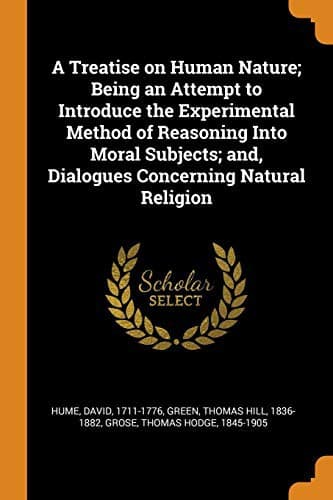
A Treatise of Human Nature: Being an Attempt to Introduce the Experimental Method Into Moral Subjects; and Dialogues Concerning Natural ReligionHume, David
PhilosophyPhilosophy
A Treatise of Human Nature: Being an Attempt to Introduce the Experimental Method Into Moral Subjects; and Dialogues Concerning Natural Religion
Hume, David
Emotions; Ethics; Knowledge, Theory of; Philosophy, English
192. Upon this the remark must occur that, if the fact of being
unextended constituted immortality, all sounds and smells must be
immortal, and that the inseparability of time from the succession of
feelings may prove that succession endless, but proves no immortality
of a soul unless there be one self-conscious subject of that
succession, identical with itself throughout it. To the supposition
of there being such a subject, which Berkeley virtually makes, his
own mode of disposing of matter suggested ready objections. In Locke,
as we have seen, the two opposite ‘things,’ thinking and material,
always appear in strict correlativity, each representing (though he
was not aware of this) the same logical necessity of substantiation.
‘Sensation convinces us that there are solid extended substances,
and reflection that there are thinking ones.’ These are not two
convictions, however, but one conviction, representing one and the
same essential condition of knowledge. Such logical necessity indeed
is misinterpreted when made a ground for believing the real existence
either of a multitude of independent things, for everything is a
‘retainer’ to everything else; [1] or of a separation of the thinking
from the material substance, since, according to Locke’s own showing,
they at least everywhere overlap; [2] or of an absolutely last
substance, which because last would be unknowable: but it is evidence
of the action of a synthetic principle of self-consciousness without
which all reference of feelings to mutually-qualified subjects
and objects, and therefore all knowledge, would be impossible. It
is idle, however, with Berkeley so to ignore the action of this
principle on the one side as to pronounce the material world a mere
succession of feelings, and so to take it for granted on the other
as to assert that every feeling implies relation to a conscious
substance. Upon such a method the latter assertion has nothing to
rest on but an appeal to the individual’s consciousness--an appeal
which avails as much or as little for material as for thinking
substance, and, in face of the apparent fact that with a knock on the
head the conscious independent substance may disappear altogether,
cannot hold its own against the suggestion that the one substance no
less than the other is reducible to a series of feelings, so closely
and constantly sequent on each other as to seem to coalesce. We
cannot substitute for this illusory appeal the valid method of an
analysis of knowledge, without finding that substantiation in matter
is just as necessary to knowledge as substantiation in mind. If this
method had been Berkeley’s he would have found a better plan for
dealing with the ‘materialism’ in vogue. Instead of trying to show
that material substance was a fiction, he would have shown that it
was really a basis of intelligible relations, and that thus all that
was fictitious about it was its supposed sensibility and consequent
opposition to the work of thought.
Public-domain text, read in full here on John Shaqi.
Reviews
Reviews
No reviews yet
Be the first to share your thoughts on this work.
Elsewhere in the archive
Join the Discussion
Join the discussion
Sign in to leave a comment or review.
Sign InorCreate an account