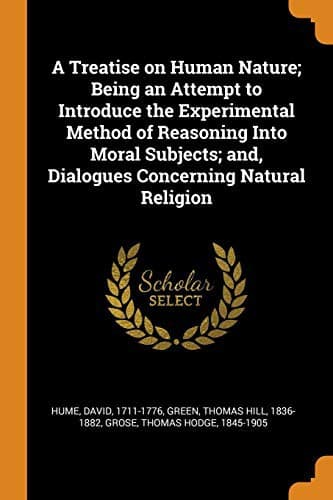
A Treatise of Human Nature: Being an Attempt to Introduce the Experimental Method Into Moral Subjects; and Dialogues Concerning Natural ReligionHume, David
PhilosophyPhilosophy
A Treatise of Human Nature: Being an Attempt to Introduce the Experimental Method Into Moral Subjects; and Dialogues Concerning Natural Religion
Hume, David
Emotions; Ethics; Knowledge, Theory of; Philosophy, English
203. The ancient sceptic (at least as represented by the ancient
philosophers), finding knowledge on the basis of distinction between
the real and apparent to be impossible, discarded the enterprise
of arriving at general truth in opposition to what appears to
the individual at any particular instant, and satisfied himself
with noting such general tendencies of expectation and desire as
would guide men in the conduct of life and enable them to get
what they wanted by contrivance and persuasion. [1] Such a state
of mind excludes all motive to the ‘interrogation of nature,’
for it recognises no ‘nature’ but the present appearance to the
individual; and this does not admit of being interrogated. The
‘positive philosopher’ has nothing in common with it but the use,
in a different sense, of the word ‘apparent.’ He plumes himself,
indeed, on not going in quest of any ‘thing-in-itself’ other than
what appears to the senses; but he distinguishes between a real
and apparent in the order of appearance, and considers the real
order of appearance, having a permanence and uniformity which
belong to no feeling as the individual feels it, to be the true
object of knowledge. No one is more severe upon ‘propensities to
believe,’ however spontaneously suggested by the ordinary sequence
of appearances, if they are found to conflict with the order of
nature as ascertained by experimental interrogation; _i.e._ with a
sequence observed (it may be) in but a single instance. Which of the
two attitudes of thought is the more nearly Hume’s, will come out as
we proceed. It was just with the distinction between the ‘real and
fantastic,’ as Locke had left it, that he had to deal; and, as will
appear, it is finally by a ‘propensity to feign,’ not by a uniform
order of natural phenomena, that he replaces the real which Locke,
according to his first mind, had found in archetypal things and their
operations on us.
[1] Cf. Plato’s ‘Protagoras,’ 323, and ‘Theaetetus,’ 167, with the
concluding paragraphs of the last part of the first book of Hume’s
‘Treatise on Human Nature.’
He adopts Berkeley’s doctrine of ideas, but without Berkeley’s saving
suppositions,
Public-domain text, read in full here on John Shaqi.
Reviews
Reviews
No reviews yet
Be the first to share your thoughts on this work.
Elsewhere in the archive
Join the Discussion
Join the discussion
Sign in to leave a comment or review.
Sign InorCreate an account