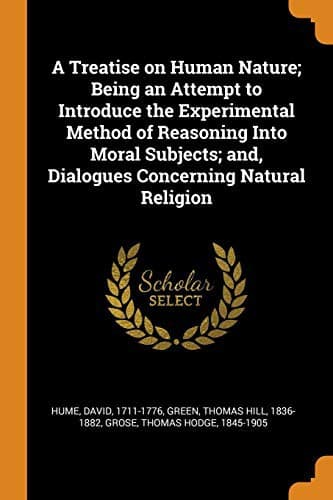
A Treatise of Human Nature: Being an Attempt to Introduce the Experimental Method Into Moral Subjects; and Dialogues Concerning Natural ReligionHume, David
PhilosophyPhilosophy
A Treatise of Human Nature: Being an Attempt to Introduce the Experimental Method Into Moral Subjects; and Dialogues Concerning Natural Religion
Hume, David
Emotions; Ethics; Knowledge, Theory of; Philosophy, English
204. We have seen that Berkeley, having reduced ‘simple ideas’ to
their simplicity by showing the illegitimacy of the assumption that
they report qualities of a matter which is itself a complex idea, is
only able to make his constructive theory march by the supposition of
the reality and knowability of ‘spirit’ and relations. ‘Ideas’ are
‘fleeting, perishable passions;’ but the relations between them are
uniform, and in virtue of this uniformity the fleeting idea may be
interpreted as a symbol of a real order. But such relations, as real,
imply the presence of the ideas to the constant mind of God, and, as
knowable, their presence to a like mind in us. We have further seen
how little Berkeley, according to the method by which he disposed of
‘abstract general ideas,’ was entitled to such a supposition. Hume
sets it aside; but the question is, whether without a supposition
virtually the same he can represent the association of ideas as doing
the work that he assigned to it.
... in regard to ‘spirit’,
205. His exclusion of Berkeley’s supposition with regard to ‘spirit’
is stated without disguise, though unfortunately not till towards
the end of the first book of the ‘Treatise on Human Nature,’ which
could not have run so smoothly if the statement had been made at
the beginning. It follows legitimately from the method, which he
inherited, of ‘looking into his mind to see how it wrought.’ ‘From
what impression,’ he asks, ‘could the idea of self be derived? It
must be some one impression that gives rise to every real idea.
But self or person is not any impression, but that to which our
several impressions and ideas are supposed to have a reference.
If any impression gives rise to the idea of self, that impression
must continue invariably the same through the whole course of our
lives, since self is supposed to exist after that manner. But there
is no impression constant and invariable. Pain and pleasure, grief
and joy, passions and sensations succeed each other, and never
all exist at the same time. It cannot, therefore, be from any of
these impressions, or from any other, that the idea of self is
derived; and, consequently, there is no such idea.’ Again: ‘When I
enter most intimately into what is called myself, I always stumble
on some particular perception of heat or cold, light or shade,
love or hatred, pain or pleasure. I never can catch myself at any
time without a perception, and never can observe anything but the
perception. When my perceptions are removed for any time, as by
sound sleep, so long am I insensible of myself, and may truly be
said not to exist.’ Thus ‘men are nothing but a bundle or collection
of different perceptions that succeed each other with inconceivable
rapidity, and are in a perpetual flux or movement. Our eyes cannot
turn in their sockets without varying our perceptions. Our thought
is still more variable than our sight. ... nor is there any single
power of the soul which remains unalterably the same perhaps for one
Public-domain text, read in full here on John Shaqi.
Reviews
Reviews
No reviews yet
Be the first to share your thoughts on this work.
Elsewhere in the archive
Join the Discussion
Join the discussion
Sign in to leave a comment or review.
Sign InorCreate an account