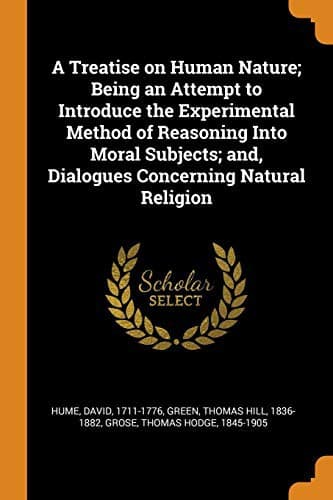
A Treatise of Human Nature: Being an Attempt to Introduce the Experimental Method Into Moral Subjects; and Dialogues Concerning Natural ReligionHume, David
PhilosophyPhilosophy
A Treatise of Human Nature: Being an Attempt to Introduce the Experimental Method Into Moral Subjects; and Dialogues Concerning Natural Religion
Hume, David
Emotions; Ethics; Knowledge, Theory of; Philosophy, English
219. It is clear that the process described in these passages
supposes ‘ab initio’ the conversion of a feeling into a conception;
in other words, the substitution of the definite individuality of
a thing, thought of under attributes, for the mere singleness in
time of a feeling that occurs after another and before a third. The
‘finding of resemblances and differences among objects that often
occur to us’ implies that each object is distinguished as one and
abiding from manifold occurrences, in the way of related feelings, in
which it is presented to us, and that these accordingly are regarded
as representing permanent relations or qualities of the object. Thus
from being related feelings, whether more or less ‘vivacious,’ they
have become, in the proper sense, ideas of relation. The difficulty
about the use of general names, as Hume puts it, really arises just
from the extent to which this process of determination by ideas of
relation, and with it the removal of the object of thought from
simple feeling, is supposed to have gone. It is because the idea is
so complex in its individuality, and because this qualification is
not understood to be the work of thought, by comparison and contrast
accumulating attributes on an object which it itself constitutes,
but is regarded as given ready-made in an impression (_i.e._ a
feeling), that the question arises whether a general proposition is
really possible or no. To all intents and purposes Hume decides that
it is not. The mind is so tied down to the particular collection of
qualities which is given to it or which it ‘finds,’ that it cannot
present one of them to itself without presenting all. Having never
found a triangle that is not equilateral or isosceles or scalene, we
cannot imagine one, for ideas can only be copies of impressions, and
the imagination, though it has a certain freedom in combining what
it finds, can invent nothing that it does not find. Thus the idea,
represented by a general name and of which an assertion, general
in form, is made, must always have a multitude of other qualities
besides those common to it with the other individuals to which the
name is applicable. If any of these, however, were included in the
predicate of the proposition, the sleeping custom, which determines
the mind to pass from the idea present to it to the others to which
the name has been applied, would be awakened, and it would be seen at
once that the predicate is not true of them. When I make a general
statement about ‘the horse,’ there must be present to my mind some
particular horse of my acquaintance, but if on the strength of this
I asserted that ‘the horse is a grey-haired animal,’ the custom of
applying the name without reference to colour would return upon me
and correct me--as it would not if the predicate were ‘four-footed.’
He virtually yields the point in regard to the _predicate_ of
propositions.
Public-domain text, read in full here on John Shaqi.
Reviews
Reviews
No reviews yet
Be the first to share your thoughts on this work.
Elsewhere in the archive
Join the Discussion
Join the discussion
Sign in to leave a comment or review.
Sign InorCreate an account