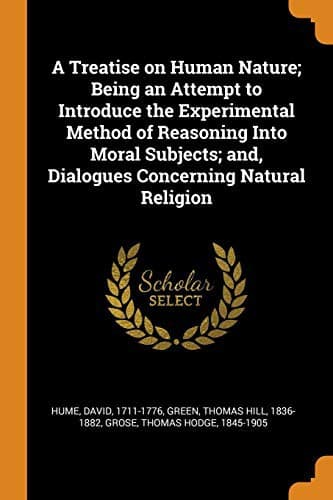
A Treatise of Human Nature: Being an Attempt to Introduce the Experimental Method Into Moral Subjects; and Dialogues Concerning Natural ReligionHume, David
PhilosophyPhilosophy
A Treatise of Human Nature: Being an Attempt to Introduce the Experimental Method Into Moral Subjects; and Dialogues Concerning Natural Religion
Hume, David
Emotions; Ethics; Knowledge, Theory of; Philosophy, English
220. It would seem then that the predicate may, though the subject
cannot, represent either a single quality, or a set of qualities
which falls far short even of those common to the class, much more of
those which characterise any individual. If I can think these apart,
or have an idea of them, as the predicate of a proposition, why
not (it may be asked) as the subject? It may be said, indeed, with
truth, that it is a mistake to think of the subject as representing
one idea and the predicate another; that the proposition as a whole
represents one idea, in the sense of a conception of relation between
attributes, and that at bottom this account of it is consistent
with Locke’s definition of knowledge as a perception of relation
between ‘ideas,’ since with him ‘ideas’ and ‘qualities’ are used
interchangeably. [1] It is no less true, however, that the relation
between attributes, which the proposition states, is a relation
between them in an individual subject. It is the nature of the
individuality of this subject, then, that is really in question.
Must it, as Hume supposed, be ‘considered’ under other qualities
than those to which the predicate relates? When the proposition
only concerns the relation between certain qualities of a spherical
figure, must the figure still be considered as of a certain colour
and material?
[1] See above, paragraph 17.
As to the subject, he equivocates between singleness of feeling and
individuality of conception.
221. The possibility of such a question being raised implies that
the step has been already taken, which Hume ignored, from feeling
to thought. His doctrine on the matter arises from that mental
equivocation, of which the effects on Locke have been already
noticed, [1] between the mere singleness of a feeling in time and the
individuality of the object of thought as a complex of relations.
If the impression is the single feeling which disappears with a
turn of the head, and the idea a weaker impression, every idea must
indeed be in one sense ‘individual,’ but in a sense that renders
all predication impossible because it empties the idea of all
content. Really, according to Hume’s doctrine of general names, it is
individual in a sense which is the most remote opposite of this, as a
multitude of ‘different resemblances and relations’ in ‘simplicity.’
It is just such an individual as Locke supposed to be found (so to
speak) ready-made in nature, and from which he supposed the mind
successively to abstract ideas less and less determinate. Such an
object Hume, coming after Berkeley, could not regard in Locke’s
fashion as a separate material existence outside consciousness. The
idea with him is a ‘copy’ not of a thing but of an ‘impression,’
but to the impression he transfers all that individualization by
qualities which Locke had ascribed to the substance found in nature;
and from the impression again transfers it to the idea which ‘is but
the weaker impression.’ Thus the singleness in time of the impression
Public-domain text, read in full here on John Shaqi.
Reviews
Reviews
No reviews yet
Be the first to share your thoughts on this work.
Elsewhere in the archive
Join the Discussion
Join the discussion
Sign in to leave a comment or review.
Sign InorCreate an account