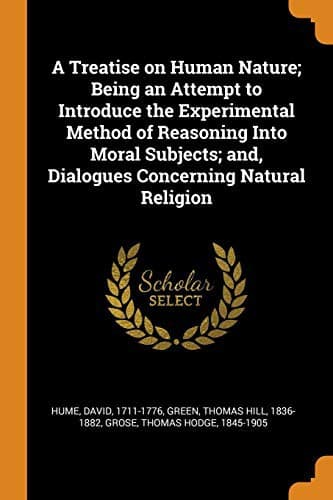
A Treatise of Human Nature: Being an Attempt to Introduce the Experimental Method Into Moral Subjects; and Dialogues Concerning Natural ReligionHume, David
PhilosophyPhilosophy
A Treatise of Human Nature: Being an Attempt to Introduce the Experimental Method Into Moral Subjects; and Dialogues Concerning Natural Religion
Hume, David
Emotions; Ethics; Knowledge, Theory of; Philosophy, English
for, as it could not be if our consciousness consisted of mere
feelings and their copies, but only in the form of the singular
proposition; because the object of thought determined by relations,
being identified with a single feeling, must be limited by the ‘this’
or ‘that’ which expresses this singleness of feeling. It is really
_this_ or _that_ globe, _this_ or _that_ man, that is the subject
of the proposition, according to Hume, even when in form it is
general. It is true that the general name ‘globe’ or ‘man’ not merely
represents a ‘particular’ globe or man, though that is all that is
presented to the mind, but also ‘raises up a custom which produces
any other individual idea for which we may have occasion.’ As this
custom, however, is neither itself an idea nor affects the singleness
of the subject idea, it does not constitute any distinction between
singular and general propositions, but only between two sorts of the
singular proposition according as it does, or does not, suggest an
indefinite series of other singular propositions, in which the same
qualities are affirmed of different individual ideas to which the
subject-name has been applied.
All propositions restricted in same way as Locke’s propositions about
real existence.
223. A customary sequence, then, of individual ideas upon each other
is the reality, which through the delusion of words (as we must
suppose) has given rise to the fiction of there being such a thing
as general knowledge. We say ‘fiction,’ for with the possibility of
general propositions, as the Greek philosophers once for all pointed
out, stands or falls the possibility of science. Locke was so far
aware of this that, upon the same principle which led him to deny the
possibility of general propositions concerning real existence, he
‘suspected’ a science of nature to be impossible, and only found an
exemption for moral and mathematical truth from this condemnation in
its ‘bare ideality.’ Hume does away with the exemption. He applies
to all propositions alike the same limitation which Locke applies to
those concerning real existence. With Locke there may very well be a
proposition which to the mind, as well as in form, is general--one of
which the subject is an ‘abstract general idea’--but such proposition
‘concerns not existence.’ As knowledge of real existence is limited
to the ‘actual present sensation,’ so a proposition about such
existence is limited to what is given in such sensation. It is a
real truth that this piece of gold is now being dissolved in aqua
regia, when the ‘particular experiment’ is going on under our eyes,
but the general proposition ‘gold is soluble’ is only an analysis of
a nominal essence. With Hume the distinction between propositions
that do, and those that do not, ‘concern existence’ disappears.
Every proposition is on the same footing in this respect, since it
must needs be a statement about an ‘idea,’ and every idea exists.
Public-domain text, read in full here on John Shaqi.
Reviews
Reviews
No reviews yet
Be the first to share your thoughts on this work.
Elsewhere in the archive
Join the Discussion
Join the discussion
Sign in to leave a comment or review.
Sign InorCreate an account