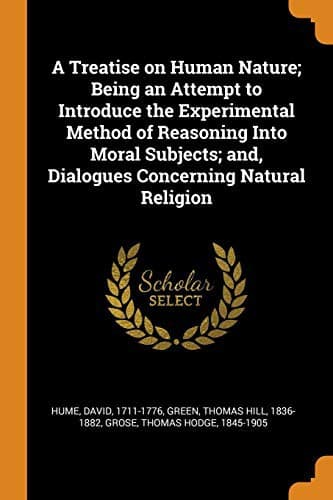
A Treatise of Human Nature: Being an Attempt to Introduce the Experimental Method Into Moral Subjects; and Dialogues Concerning Natural ReligionHume, David
PhilosophyPhilosophy
A Treatise of Human Nature: Being an Attempt to Introduce the Experimental Method Into Moral Subjects; and Dialogues Concerning Natural Religion
Hume, David
Emotions; Ethics; Knowledge, Theory of; Philosophy, English
‘Every object that is presented must necessarily be existent. ...
Whatever we conceive, we conceive to be existent. Any idea we please
to form is the idea of a being; and the idea of a being is any idea
we please to form’. [1] But since, according to him, the idea cannot
be separated, as Locke supposed it could, from the conditions ‘that
determine it to this or that particular existence,’ propositions
of the sort which Locke understood by ‘general propositions
concerning substances,’ though if they were possible they would
‘concern existence’ as much as any, are simply impossible. Hume,
in short, though he identifies the real and nominal essences which
Locke had distinguished, yet limits the nominal essence by the same
‘particularity in space and time’ by which Locke had limited the real.
[1] p. 370 [Book I, part II., sec. VI.]
The question, how the _singular_ proposition is possible, the vital
one.
224. A great advance in simplification has been made when the false
sort of ‘conceptualism’ has thus been got rid of--that conceptualism
which opposes knowing and being under the notion that things,
though merely individual in reality, may be known as general. This
riddance having been achieved, as it was by Hume, the import of the
proposition becomes the central question of philosophy, the answer
to which must determine our theory of real existence just as much
as of the mind. The issue may be taken on the proposition in its
singular no less than in its general form. The weakness of Hume’s
opponents, indeed, has lain primarily in their allowing that his
doctrine would account for any significant predication whatever,
as distinct from exclamations prompted by feelings as they occur.
This has been the inch, which once yielded, the full ell of his
nominalism has been easily won; just as Locke’s empiricism becomes
invincible as soon as it is admitted that qualified things are ‘found
in nature’ without any constitutive action of the mind. As the only
effective way of dealing with Locke is to ask,--After abstraction
of all that he himself admitted to be the creation of thought, what
remains to be merely found?--so Hume must be met _in limine_ by the
question whether, apart from such ideas of relation as according to
his own showing are not simple impressions, so much as the singular
proposition is possible. If not, then the singularity of such
proposition does not consist in any singleness of presentation to
sense; it is not the ‘particularity in time’ of a present feeling;
and the exclusion of generality, whether in thoughts or in things,
as following from the supposed necessity of such singleness or
particularity, is quite groundless.
Not relations of resemblance only, but those of quantity also,
treated by Hume as feelings.
Public-domain text, read in full here on John Shaqi.
Reviews
Reviews
No reviews yet
Be the first to share your thoughts on this work.
Elsewhere in the archive
Join the Discussion
Join the discussion
Sign in to leave a comment or review.
Sign InorCreate an account