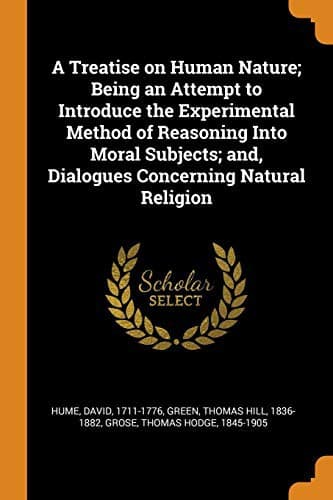
A Treatise of Human Nature: Being an Attempt to Introduce the Experimental Method Into Moral Subjects; and Dialogues Concerning Natural ReligionHume, David
PhilosophyPhilosophy
A Treatise of Human Nature: Being an Attempt to Introduce the Experimental Method Into Moral Subjects; and Dialogues Concerning Natural Religion
Hume, David
Emotions; Ethics; Knowledge, Theory of; Philosophy, English
233. ‘The first notion of space and extension,’ he says, ‘is derived
solely from the senses of sight and feeling: nor is there anything
but what is coloured or tangible that has parts disposed after
such a manner as to convey the idea.’ Now, there may be a meaning
of ‘derivation,’ according to which no one would care to dispute
the first clause of this sentence. Those who hold that _really_,
i.e. _for a consciousness to which the distinction between real and
unreal is possible_, there is no feeling except such as is determined
by thought, are yet far from holding that the determination is
arbitrary; that any and every feeling is potentially any and every
conception. Of the feelings to which the visual and tactual nerves
are organic, as they would be for a merely feeling consciousness,
nothing, they hold, can be said; in that sense they are an ἄπειρον;
[1] but for the thinking consciousness, or (which is the same) as
they _really_ are, these feelings do, while those to which other
nerves are organic do not, form the specific possibility of the
conception of space. According to this meaning of the words, all
must admit that ‘the first notion of space and extension is derived
from the senses of sight and feeling;’ though it does not follow
that a repeated or continued activity of either sense is necessary
to the continued presence of the notion. With Hume, however, the
derivation spoken of must mean that the notion of space is, to begin
with, simply a visual or tactual feeling, and that such it remains,
though with indefinite abatement and revival in the liveliness of the
feeling, according to the amount of which it is called ‘impression’
or ‘idea.’ If we supposed him to mean, not that the notion of space
was either a visual or tactual feeling indifferently, but that it
was a compound result of both, [2] we should merely have to meet
a further difficulty as to the possibility of such composition of
feelings when their inward synthesis in a soul, and the outward in a
body, have been alike excluded. In the next clause of the sentence,
however, we find that for visual and tactual feelings there are
quietly substituted ‘coloured and tangible objects, having parts so
disposed as to convey the idea of extension.’ It is in the light of
this latter clause that the uncritical reader interprets the former.
He reads back the plausibility of the one into the other, and, having
done so, finds the whole plausible. Now this plausibility of the
latter clause arises from its implying a three-fold distinction--a
distinction of colour or tangibility on the one side from the
disposition of the parts on the other; a distinction of the colour,
tangibility and disposition of parts alike from an object to which
they belong; and a distinction of this object from the idea that it
conveys. In other words, it supposes a negative answer to the three
following questions:--Is the idea of extension the same as that of
Public-domain text, read in full here on John Shaqi.
Reviews
Reviews
No reviews yet
Be the first to share your thoughts on this work.
Elsewhere in the archive
Join the Discussion
Join the discussion
Sign in to leave a comment or review.
Sign InorCreate an account