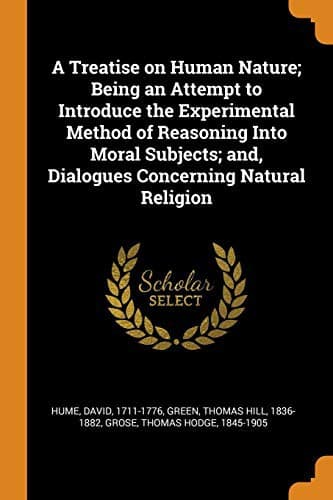
A Treatise of Human Nature: Being an Attempt to Introduce the Experimental Method Into Moral Subjects; and Dialogues Concerning Natural ReligionHume, David
PhilosophyPhilosophy
A Treatise of Human Nature: Being an Attempt to Introduce the Experimental Method Into Moral Subjects; and Dialogues Concerning Natural Religion
Hume, David
Emotions; Ethics; Knowledge, Theory of; Philosophy, English
but are ‘relations between permanent parts,’ like those of space.
It is for this reason that its doctrine about geometry has always
been found the most easily assailable point of the ‘sensational’
philosophy. Locke distinguishes the ideas of space and of duration
as got, the one ‘from the permanent parts of space,’ the other ‘from
the fleeting and perpetually perishing parts of succession.’ [4] He
afterwards prefers the term ‘expansion’ to space, as the opposite
of duration, because it brings out more clearly the distinction
of a relation between permanent parts from that between ‘fleeting
successive parts which never exist together.’ How, then, can a
consciousness consisting simply of ‘fleeting successive parts’ either
be or represent that of which the differentia is that its parts are
permanent and co-exist?
[1] As implying no distinction from, or reference to, a thing causing
and a subject experiencing it. See above, paragraphs 195 and 208, and
the passages there referred to.
[2] ‘To hate, to love, to think, to feel, to see; all this is nothing
but to perceive.’ p. 371 [Book I, part II., sec. IV.]. ‘When I
shut my eyes and _think_ of my chamber, the ideas I form are exact
representations of the impressions I _felt_.’ p. 312 [Book I, part
I., sec. I.].
[3] See above, paragraphs 172 & 176.
[4] Essay Book II. chap. xiv. sec. 1.
Hume cannot make space a ‘perception’ without being false to his own
account of perception;
237. If this crux had been fairly faced by Hume, he must have seen
that the only way in which he could consistently deal with it was
by radically altering, with whatever consequence to the sciences,
Locke’s account of space. As it was, he did not face it, but--whether
intentionally or only in effect--disguised it by availing himself of
the received usages of language, which roughly represent a theory
the exact opposite of his own, to cover the incompatibility between
the established view of the nature of space, and his own reduction
of it to feeling. A very little examination of the passage, quoted
at large above, will show that while in it a profession is made
of identifying extension and a certain sort of perception with
each other, its effect is not really to reduce extension to such a
perception as Hume elsewhere explains all perceptions to be, but
to transfer the recognised properties of extension which with such
reduction would disappear, to something which for the time he chooses
to reckon a perception, but which he can only so reckon at the cost
of contradicting his whole method of dealing with the ideas of God,
the soul, and the world. The passage, in fact, is merely one sample
of the continued shuffle by which Hume on the one hand ascribes to
feeling that intelligible content which it only derives from relation
to objects of thought, and on the other disposes of these objects
because they are not feelings.
... as appears if we put ‘feeling’ for ‘perception’ in the passages
in question.
Public-domain text, read in full here on John Shaqi.
Reviews
Reviews
No reviews yet
Be the first to share your thoughts on this work.
Elsewhere in the archive
Join the Discussion
Join the discussion
Sign in to leave a comment or review.
Sign InorCreate an account