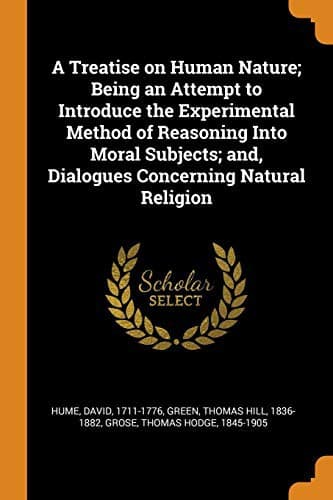
A Treatise of Human Nature: Being an Attempt to Introduce the Experimental Method Into Moral Subjects; and Dialogues Concerning Natural ReligionHume, David
PhilosophyPhilosophy
A Treatise of Human Nature: Being an Attempt to Introduce the Experimental Method Into Moral Subjects; and Dialogues Concerning Natural Religion
Hume, David
Emotions; Ethics; Knowledge, Theory of; Philosophy, English
238. ‘The table, which just now appears to me, is only a perception,
and all its qualities are qualities of a perception. Now, the most
obvious of all its qualities is extension. The perception consists
of parts. These parts are so situated as to afford us the notion
of distance and contiguity, of length, breadth, and thickness,’
&c., &c. If, now, throughout this statement (as according to Hume’s
doctrine we are entitled to do) we write _feeling_ for ‘perception’
and ‘notion,’ it will appear that this table is a feeling, which
has another feeling, called extension, as one of its qualities; and
that this latter feeling consists of parts. These, in turn, must be
themselves feelings, since the parts of which a perception consists
must be themselves perceived, and, being perceived, must, according
to Hume, be themselves perceptions which = feelings. These feelings,
again, afford us other feelings of certain relations--distance and
contiguity, &c.--feelings which, as Hume’s doctrine allows of no
distinction between the feeling and that of which it is the feeling,
must be themselves relations. Thus it would seem that a feeling may
have another feeling as one of its qualities; that the feeling, which
is thus a quality, has other feelings as its co-existent parts; and
that the feelings which are parts ‘afford us’ other feelings which
are relations. Is that sense or nonsense?
To make sense of them, we must take perception to mean perceived
thing,
239. To this a follower of Hume, if he could be brought to admit the
legitimacy of depriving his master of the benefit of synonyms, might
probably reply, that the apparent nonsense only arises from our being
unaccustomed to such use of the term ‘feeling;’ that the table is a
‘bundle of feelings,’ actual and possible, of which the actual one
of sight suggests a lively expectation, easily confused with the
presence, of the others belonging to the other senses; that any one
of these may be considered a quality of the total impression formed
by all; that the feeling thus considered, if it happens to be visual,
may not improperly be said to consist of other feelings, as a whole
consists of parts, since it is the result of impressions on different
parts of the retina, and from a different point of view even itself
to be the relation between the parts, just as naturally as a mutual
feeling of friendship may be said either to consist of the loves of
the two parties to the friendship, or to constitute the relation
between them. Such language represents those modern adaptations of
Hume, which retain his identification of the real with the felt but
ignore his restrictions on the felt. Undoubtedly, if Hume allowed
us to drop the distinction between feeling as it might be for a
merely feeling consciousness, and feeling as it is for a thinking
consciousness, the objection to his speaking of feeling in those
terms, in which it must be spoken of if extension is to be a feeling,
Public-domain text, read in full here on John Shaqi.
Reviews
Reviews
No reviews yet
Be the first to share your thoughts on this work.
Elsewhere in the archive
Join the Discussion
Join the discussion
Sign in to leave a comment or review.
Sign InorCreate an account