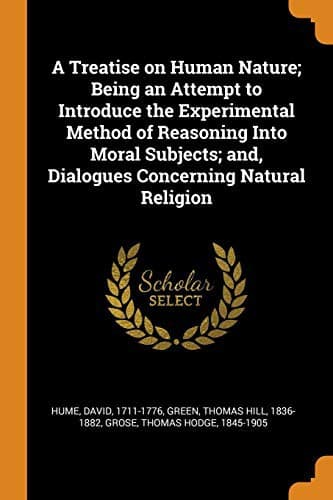
A Treatise of Human Nature: Being an Attempt to Introduce the Experimental Method Into Moral Subjects; and Dialogues Concerning Natural ReligionHume, David
PhilosophyPhilosophy
A Treatise of Human Nature: Being an Attempt to Introduce the Experimental Method Into Moral Subjects; and Dialogues Concerning Natural Religion
Hume, David
Emotions; Ethics; Knowledge, Theory of; Philosophy, English
the impressions, it must have the specific sensuous character which
belongs to these. It must be a multitude of sounds, a multitude of
tastes, a multitude of smells--these one after the other in endless
series. How then can such a series of impressions become such an
idea, _i.e._ so grow fainter as to be ‘conjoined’ indifferently ‘with
any impressions whatever’?
How can he adjust the exact sciences to his theory of space and time?
263. The case then between Hume and the conceptions which the exact
sciences presuppose, as we have so far examined it, stands thus. Of
the idea of quantity, as such, he gives no account whatever. We are
told, indeed, that there are ‘unites which can exist alone,’ _i.e._
can be felt separately, and which are indivisible; but how such
unites, being separate impressions, can form a sum or number, or what
meaning a unite can have except as one of a number--how again a sum
formed of separate unites can be a continuous whole or magnitude--we
are not told at all. Of the ideas of space and time we do find an
account. They are said to be given in impressions, but, to justify
this account of them, each impression has to be taken to be at the
same time a consciousness of the manner of its own existence, as
determined by relation to other impressions not felt along with it
and as interpreted in a way that presupposes the unexplained idea
of quantity. With this supposed origin of the ideas the sciences
resting on them have to be adjusted. They may take the relations of
number and magnitude, time and space, for granted, as ‘qualities of
perceptions,’ and no question will be asked as to how the perceptions
come to assume qualities confessed to be ‘independent of their own
nature.’ It is only when they treat them in a way incompatible not
merely with their being feelings--that must always be the case--but
with their being relations between felt things, that they are
supposed to cross the line which separates experimental knowledge
from metaphysical jargon. So long then as space is considered merely
as the relation of externality between objects of the ‘outer,’ time
as that of succession between objects of the ‘inner,’ sense--in
other words, so long as they remain what they are to the earliest
self-consciousness and do not become the subject matter of any
science of quantity--if we sink the difference between feelings and
relations of felt things, and ask no questions about the origin of
the distinction between outer and inner sense, they may be taken as
data of sensitive experience. It is otherwise when they are treated
as quantities, and it is their susceptibility of being so treated
that, rightly understood, brings out their true character as the
intelligible element in sensitive experience. But Hume contrives at
once to treat them as quantities, thus seeming to give the exact
sciences their due, and yet to appeal to their supposed origin in
sense as evidence of their not having properties which, if they are
Public-domain text, read in full here on John Shaqi.
Reviews
Reviews
No reviews yet
Be the first to share your thoughts on this work.
Elsewhere in the archive
Join the Discussion
Join the discussion
Sign in to leave a comment or review.
Sign InorCreate an account