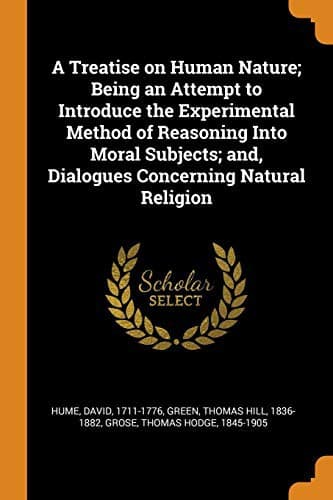
A Treatise of Human Nature: Being an Attempt to Introduce the Experimental Method Into Moral Subjects; and Dialogues Concerning Natural ReligionHume, David
PhilosophyPhilosophy
A Treatise of Human Nature: Being an Attempt to Introduce the Experimental Method Into Moral Subjects; and Dialogues Concerning Natural Religion
Hume, David
Emotions; Ethics; Knowledge, Theory of; Philosophy, English
quantities, they certainly must have. Having thus seemingly disposed
of the purely intelligible character of quantity in its application
to space and time, he can more safely ignore what he could not so
plausibly dispose of--its pure intelligibility as number.
In order to seem to do so, he must get rid of ‘Infinite Divisibility’.
264. The condition of such a method being acquiesced in is, that
quantity in all its forms should be found reducible to ultimate
unites or indivisible parts in the shape of separate impressions.
Should it be found so, the whole question indeed, how ideas of
relation are possible for a merely feeling consciousness, would
still remain, but mathematics would stand on the same footing
with the experimental sciences, as a science of relations between
impressions. Upon this reducibility, then, we find Hume constantly
insisting. In regard to number indeed he could not ignore the fact
that the science which deals with it recognizes no ultimate unite,
but only such a one as ‘is itself a true number.’ But he passes
lightly over this difficulty with the remark that the divisible
unite of actual arithmetic is a ‘fictitious denomination’--leaving
his reader to guess how the fiction can be possible if the real
unite is a separate indivisible impression--and proceeds with the
more hopeful task of resolving space into such impressions. He is
well aware that the constitution of space by impressions and its
constitution by indivisible parts stand or fall together. If space is
a compound impression, it is made up of indivisible parts, for there
is a ‘minimum visibile’ and by consequence a minimum of imagination;
and conversely, if its parts are indivisible, they can be nothing
but impressions; for, being indivisible, they cannot be extended,
and, not being extended, they must be either simple impressions or
nothing. With that instinct of literary strategy which never fails
him, Hume feels that the case against infinite divisibility, from its
apparent implication of an infinite capacity in the mind, is more
effective than that in favour of space being a compound impression,
and accordingly puts that to the front in the Second Part of the
Treatise, in order, having found credit for establishing it, to argue
back to the constitution of space by impressions. In fact, however,
it is on the supposed composition of all quantity from separate
impressions that his argument against its infinite divisibility rests.
Quantity made up of impressions, and there must be a least possible
impression.
Public-domain text, read in full here on John Shaqi.
Reviews
Reviews
No reviews yet
Be the first to share your thoughts on this work.
Elsewhere in the archive
Join the Discussion
Join the discussion
Sign in to leave a comment or review.
Sign InorCreate an account