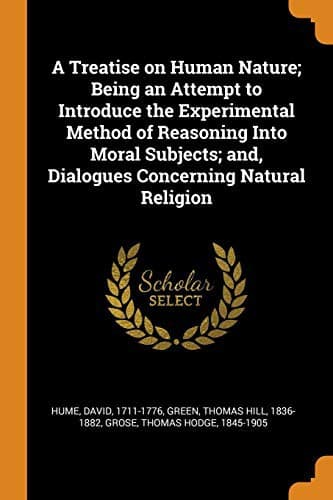
A Treatise of Human Nature: Being an Attempt to Introduce the Experimental Method Into Moral Subjects; and Dialogues Concerning Natural ReligionHume, David
PhilosophyPhilosophy
A Treatise of Human Nature: Being an Attempt to Introduce the Experimental Method Into Moral Subjects; and Dialogues Concerning Natural Religion
Hume, David
Emotions; Ethics; Knowledge, Theory of; Philosophy, English
273. It is the necessity then, according to his theory, of making
space an impression that throughout underlies Hume’s argument against
its infinite divisibility; and, as we have seen, the same theory
which excludes its infinite divisibility logically extinguishes it as
a quantity, divisible and measurable, altogether. He of course does
not recognize this consequence. He is obliged indeed to admit that
in regard to the proportions of ‘greater, equal and less,’ and the
relations of different parts of space to each other, no judgments
of universality or exactness are possible. We may judge of them,
however, he holds, with various approximations to exactness, whereas
upon the supposition of infinite divisibility, as he ingeniously
makes out, we could not judge of them at all. He ‘asks the
mathematicians, what they mean when they say that one line or surface
is equal to, or greater or less than, another.’ If they ‘maintain the
composition of extension by indivisible points,’ their answer, he
supposes, will be that ‘lines or surfaces are equal when the numbers
of points in each are equal.’ This answer he reckons ‘just,’ but the
standard of equality given is entirely useless. ‘For as the points
which enter into the composition of any line or surface, whether
perceived by the sight or touch, are so minute and so confounded with
each other that ’tis utterly impossible for the mind to compute their
number, such a computation will never afford us a standard by which
we may judge of proportions.’ The opposite sect of mathematicians,
however, are in worse case, having no standard of equality whatever
to assign. ‘For since, according to their hypothesis, the least as
well as greatest figures contain an infinite number of parts, and
since infinite numbers, properly speaking, can neither be equal
nor unequal with respect to each other, the equality or inequality
of any portion of space can never depend on any proportion in the
number of their parts.’ His own doctrine is ‘that the only useful
notion of equality or inequality is derived from the whole united
appearance, and the comparison of, particular objects.’ The judgments
thus derived are in many cases certain and infallible. ‘When the
measure of a yard and that of a foot are presented, the mind can no
more question that the first is longer than the second than it can
doubt of those principles which are most clear and self-evident.’
Such judgments, however, though ‘sometimes infallible, are not always
so.’ Upon a ‘review and reflection’ we often ‘pronounce those objects
equal which at first we esteemed unequal,’ and vice versâ. Often
also ‘we discover our error by a juxtaposition of the objects; or,
where that is impracticable, by the use of some common and invariable
measure which, being successively applied to each, informs us of
their different proportions. And even this correction is susceptible
of a new correction, and of different degrees of exactness, according
Public-domain text, read in full here on John Shaqi.
Reviews
Reviews
No reviews yet
Be the first to share your thoughts on this work.
Elsewhere in the archive
Join the Discussion
Join the discussion
Sign in to leave a comment or review.
Sign InorCreate an account