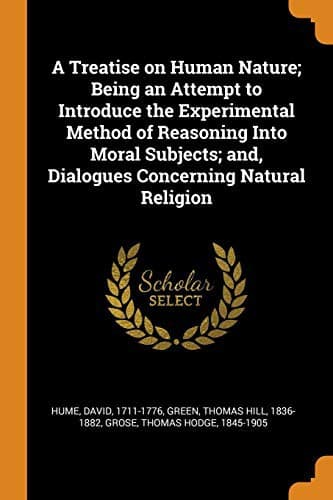
A Treatise of Human Nature: Being an Attempt to Introduce the Experimental Method Into Moral Subjects; and Dialogues Concerning Natural ReligionHume, David
PhilosophyPhilosophy
A Treatise of Human Nature: Being an Attempt to Introduce the Experimental Method Into Moral Subjects; and Dialogues Concerning Natural Religion
Hume, David
Emotions; Ethics; Knowledge, Theory of; Philosophy, English
to the nature of the instrument by which we measure the bodies, and
the care which we employ in the comparison.’ [1]
[1] Pp. 351-53. [Book I, part II., sec. IV.]
The universal propositions of geometry either untrue or unmeaning.
274. Such indefinite approach to exactness is all that Hume can allow
to the mathematician. But it is undoubtedly another and an absolute
sort of exactness that the mathematician himself supposes when he
pronounces all right angles equal. Such perfect equality ‘beyond what
we have instruments and art’ to ascertain, Hume boldly calls a ‘mere
fiction of the mind, useless as well as incomprehensible’. [1] Thus
when the mathematician talks of certain angles as always equal, of
certain lines as never meeting, he is either making statements that
are untrue or speaking of nonentities. If his ‘lines’ and ‘angles’
mean ideas that we can possibly have, his universal propositions are
untrue; if they do not, according to Hume they can mean nothing.
He says, for instance, that ‘two right lines cannot have a common
segment;’ but of such ideas of right lines as we can possibly have
this is only true ‘where the right lines incline upon each other with
a sensible angle.’ [2] It is not true when they ‘approach at the rate
of an inch in 20 leagues.’ According to the ‘original standard of a
right line,’ which is ‘nothing but a certain general appearance, ’tis
evident right lines may be made to concur with each other’. [3] Any
other standard is a ‘useless and incomprehensible fiction.’ Strictly
speaking, according to Hume, we have it not, but only a tendency to
suppose that we have it arising from the progressive correction of
our actual measurements. [4]
[1] P. 353. [Book I, part II., sec. IV.]
[2] Cf. Aristotle, Metaph. 998a, on a corresponding view ascribed to
Protagoras.
[3] P. 356. [Book I, part II., sec. IV.]
[4] P. 354. [Book I, part II., sec. IV.]
Distinction between Hume’s doctrine and that of the hypothetical
nature of mathematics.
Public-domain text, read in full here on John Shaqi.
Reviews
Reviews
No reviews yet
Be the first to share your thoughts on this work.
Elsewhere in the archive
Join the Discussion
Join the discussion
Sign in to leave a comment or review.
Sign InorCreate an account