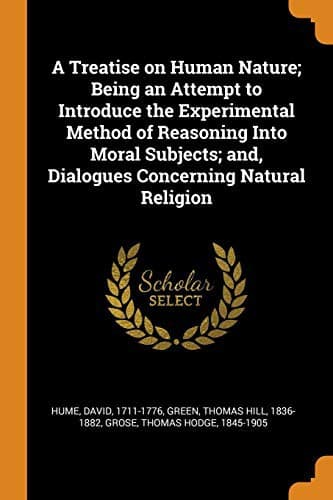
A Treatise of Human Nature: Being an Attempt to Introduce the Experimental Method Into Moral Subjects; and Dialogues Concerning Natural ReligionHume, David
PhilosophyPhilosophy
A Treatise of Human Nature: Being an Attempt to Introduce the Experimental Method Into Moral Subjects; and Dialogues Concerning Natural Religion
Hume, David
Emotions; Ethics; Knowledge, Theory of; Philosophy, English
The admission that no relations of quantity are data of sense removes
difficulty as to general propositions about them.
276. Here, as elsewhere, what we have to lament is not that Hume
‘pushed his doctrine too far,’ so far as to exclude ideas of those
exact proportions in space with which geometry purports to deal,
but that he did not carry it far enough to see that it excluded all
ideas of quantitative relations whatever. He thus pays the penalty
for his equivocation between a feeling of colour and a disposition
of coloured points. Even alongside of his admission that ‘relations
of space and time’ are independent of the nature of the ideas so
related, which amounts to the admission that of space and time there
are no ideas at all in his sense of the word, he allows himself to
treat ‘proportions between spaces’ as depending entirely on our
ideas of the spaces--depending on ideas which in the context he
by implication admits that we have not. [1] If, instead of thus
equivocating, he had asked himself how sensations of colour and touch
could be added or divided, how one could serve as a measure of the
size of another, he might have seen that only in virtue of that in
the ‘general appearance’ of objects which, in his own language, is
‘independent of the nature of the ideas themselves’--_i.e._ which
does not belong to them as feelings, but is added by the comparing
and combining thought--are the proportions of greater, less, and
equal predicable of them at all; that what thought has thus added,
viz. limitation by mutual externality, it can abstract; and that by
such abstraction of the limit it obtains those several terminations,
as Hume well calls them--the surface terminating bodies, the line
terminating surfaces, the point terminating lines--from which it
constructs the world of pure space: that thus the same action of
thought in sense, which alone renders appearances measurable, gives
an object matter which, because the pure construction of thought, we
can measure exactly and with the certainty that the judgment based on
a comparison of magnitudes in a single case is true of all possible
cases, because in none of these can any other conditions be present
than those which we have consciously put there.
[1] Part III. § 1, sub init.
Hume does virtually admit this in regard to numbers.
Public-domain text, read in full here on John Shaqi.
Reviews
Reviews
No reviews yet
Be the first to share your thoughts on this work.
Elsewhere in the archive
Join the Discussion
Join the discussion
Sign in to leave a comment or review.
Sign InorCreate an account