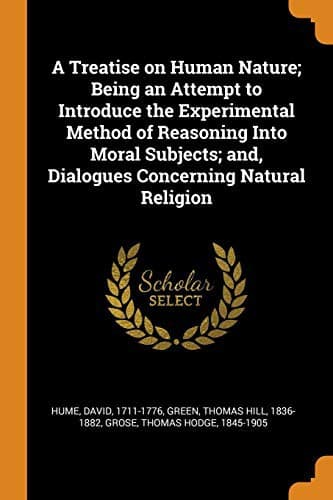
A Treatise of Human Nature: Being an Attempt to Introduce the Experimental Method Into Moral Subjects; and Dialogues Concerning Natural ReligionHume, David
PhilosophyPhilosophy
A Treatise of Human Nature: Being an Attempt to Introduce the Experimental Method Into Moral Subjects; and Dialogues Concerning Natural Religion
Hume, David
Emotions; Ethics; Knowledge, Theory of; Philosophy, English
277. To have arrived at this conclusion Hume had only to extend to
proportions in space the principle upon which the impossibility of
sensualizing arithmetic compels him to deal with proportions in
number. ‘We are possessed,’ he says, ‘of a precise standard by which
we can judge of the equality and proportion of numbers; and according
as they correspond or not to that standard we determine their
relations without any possibility of error. When two numbers are so
combined, as that the one has always an unite answering to every
unite of the other, we pronounce them equal’. [1] Now what are the
unites here spoken of? If they were those single impressions which he
elsewhere [2] seems to regard as alone properly unites, the point of
the passage would be gone, for combinations of such unites could at
any rate only yield those ‘general appearances’ of whose proportions
we have been previously told there can be no precise standard. They
can be no other than those unites which, not being impressions, he
has to call ‘fictitious denominations’--unites which are nothing
except in relation to each other and of which each, being in turn
divisible, is itself a true number. We can easily retort upon Hume,
then, when he argues that the supposition of infinite divisibility
is incompatible with any comparison of quantities because with any
unite of measurement, that, according to his own virtual admission,
in the only case where such comparison is exact the ultimate unite
of measurement is still itself divisible; which, indeed, is no
more than saying that whatever measures quantity must itself be a
quantity, and that therefore quantity is infinitely divisible. If
Hume, instead of slurring over this characteristic of the science of
number, had set himself to explain it, he would have found that the
only possible explanation of it was one equally applicable to the
science of space--that what is true of the unite, as the abstraction
of distinctness, is true also of the abstraction of externality. As
the unite, because constituted by relation to other unites, so soon
as considered breaks into multiplicity, and only for that reason is
a quantity by which other quantities can be measured; so is it also
with the limit in whatever form abstracted, whether as point, line,
or surface. If the fact that number can have no least part since each
part is itself a number or nothing, so far from being incompatible
with the finiteness of number, is the consequence of that finiteness,
neither can the like attribute in spaces be incompatible with their
being definite magnitudes, that can be compared with and measured
by each other. The real difference, which is also the rationale of
Hume’s different procedure in the two cases, is that the conception
of space is more easily confused than that of number with the
feelings to which it is applied, and which through such application
become sensible spaces. Hence the liability to the supposition,
Public-domain text, read in full here on John Shaqi.
Reviews
Reviews
No reviews yet
Be the first to share your thoughts on this work.
Elsewhere in the archive
Join the Discussion
Join the discussion
Sign in to leave a comment or review.
Sign InorCreate an account