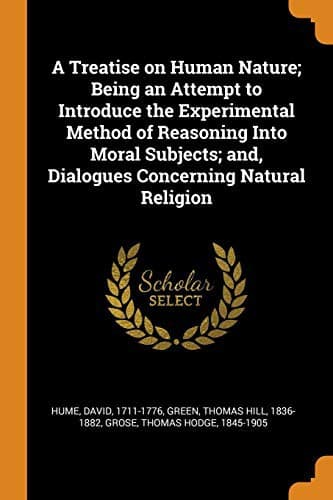
A Treatise of Human Nature: Being an Attempt to Introduce the Experimental Method Into Moral Subjects; and Dialogues Concerning Natural ReligionHume, David
PhilosophyPhilosophy
A Treatise of Human Nature: Being an Attempt to Introduce the Experimental Method Into Moral Subjects; and Dialogues Concerning Natural Religion
Hume, David
Emotions; Ethics; Knowledge, Theory of; Philosophy, English
which is at bottom Hume’s, that the last feeling in the process of
diminution before such sensible space disappears (being the ‘minimum
visibile’) is the least possible portion of space.
[1] P. 374. [Book I, part III., sec. I.]
[2] Above, par. 258.
With Hume idea of vacuum impossible, but logically not more so than
that of space.
278. Just as that reduction of consciousness to feeling, which
really excludes the idea of quantity altogether, is by Hume only
recognised as incompatible with its infinite divisibility, so it is
not recognised as extinguishing space altogether, but only space as
a vacuum. If it be true, he says, ‘that the idea of space is nothing
but the idea of visible or tangible points distributed in a certain
order, it follows that we can form no idea of vacuum, or space where
there is nothing visible or tangible’. [1] Here as elsewhere the
acceptability of his statement lies in its being taken in a sense
which according to his principles cannot properly belong to it. It
is one doctrine that the ideas of space and body are essentially
correlative, and quite another that the idea of space is equivalent
to a feeling of sight or touch. It is of the latter doctrine that
Hume’s denial of a vacuum is the corollary; but it is the former
that gains acceptance for this denial in the mind of his reader.
Space we have already spoken of as the relation of externality. If,
abstracting this relation from the world of which it is the uniform
but most elementary determination, we regard it as a relation between
objects having no other determination, these become spaces and
nothing but spaces--space pure and simple, _vacuum_. But we have
known the world in confused fulness before we detach its constituent
relations in the clearness of unreal abstraction. We have known
bodies συγκεχυμένος [2], before we think their limits apart and out
of these construct a world of pure space. It is thus in a sense true
that in the development of our consciousness an idea of body precedes
that of space, though the _abstraction_ of space--the detachment of
the relation so-called from the real complex of relations--precedes
that of body; and it is this fact that, in the face of geometry,
strengthens common sense in its position that an idea of vacuum is
impossible. It is not, however, the inseparability of space from body
whether in reality or for our consciousness, but its identity with a
certain sort of feeling, that is implied in Hume’s exclusion of the
idea of vacuum. ‘Body,’ as other than feeling, is with him as much a
fiction as vacuum. That there can be no idea of vacuum, is thus in
fact merely his negative way of putting that proposition of which the
positive form is, that space is a compound impression of sight and
touch. Having examined that proposition in the positive, we need not
examine it again in the negative form. It will be more to the purpose
to enquire whether the ‘tendency to suppose’ or ‘propensity to feign’
Public-domain text, read in full here on John Shaqi.
Reviews
Reviews
No reviews yet
Be the first to share your thoughts on this work.
Elsewhere in the archive
Join the Discussion
Join the discussion
Sign in to leave a comment or review.
Sign InorCreate an account