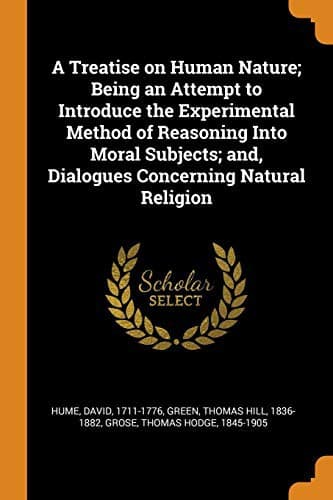
A Treatise of Human Nature: Being an Attempt to Introduce the Experimental Method Into Moral Subjects; and Dialogues Concerning Natural ReligionHume, David
PhilosophyPhilosophy
A Treatise of Human Nature: Being an Attempt to Introduce the Experimental Method Into Moral Subjects; and Dialogues Concerning Natural Religion
Hume, David
Emotions; Ethics; Knowledge, Theory of; Philosophy, English
302. The problem of identity necessarily arises from the fusion of
reality and feeling. We must once again recall the propositions in
which Hume represents this fusion--that ‘everything which enters
the mind is both in reality and appearance as the perception;’
that ‘so far as the senses are judges, all perceptions are the
same in the manner of their existence;’ that ‘perceptions’ are
either impressions, or ideas which are ‘fainter impressions;’ and
‘impressions are internal and perishing existences, and appear
as such.’ If these propositions are true--and the ‘new way of
ideas’ inevitably leads to them--how is it that we _believe_ in ‘a
_continued_ existence of objects even when they are not present
to the senses,’ and an existence ‘distinct from the mind and
perception’? They are the same questions from which Berkeley derived
his demonstration of an eternal mind--a demonstration premature
because, till the doctrine of ‘ideas,’ and of mind as their subject,
had been definitely altered in a way that Berkeley did not attempt,
it was explaining a belief difficult to account for by one wholly
unaccountable. Before Theism could be exhibited with the necessity
which Locke claimed for it, it was requisite to try what could be
done with association of ideas and ‘propensities to feign’ in the
way of accounting for the world of knowledge, in order that upon
their failure another point of departure than Locke’s might be found
necessary. The experiment was made by Hume. He has the merit, to
begin with, of stating the nature of identity with a precision which
we found wanting in Locke. ‘In that proposition, _an object is the
same with itself_, if the idea expressed by the word _object_ were
no ways distinguished from that meant by _itself_, we really should
mean nothing.’ ‘On the other hand, a multiplicity of objects can
never convey the idea of identity, however resembling they may be
supposed. ... Since then both number and unity are incompatible with
the relation of identity, it must lie in something that is neither
of them. But at first sight this seems impossible.’ The explanation
is that when ‘we say that an object is the same with itself, we mean
that the object existent at one time is the same with itself existent
at another. By this means we make a difference betwixt the idea meant
by the word _object_ and that meant by _itself_ without going the
length of number, and at the same time without restraining ourselves
to a strict and absolute unity.’ In other words, identity means the
unity of a thing through a multiplicity of times; or, as Hume puts
it, ‘the invariableness and uninterruptedness of any object through a
supposed variation of time’. [1]
[1] Pp. 489, 490. [Book I, part IV., sec. II.]
Properly with him it is a fiction, in the sense that we have no
such idea. Yet he implies that we have such idea, in saying that we
mistake something else for it.
Public-domain text, read in full here on John Shaqi.
Reviews
Reviews
No reviews yet
Be the first to share your thoughts on this work.
Elsewhere in the archive
Join the Discussion
Join the discussion
Sign in to leave a comment or review.
Sign InorCreate an account