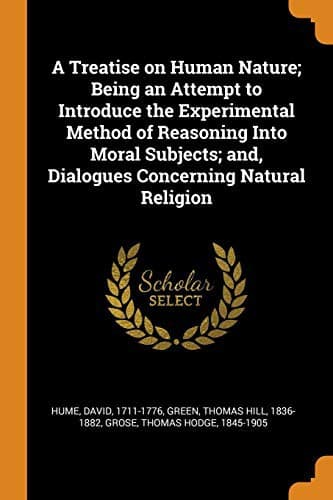
A Treatise of Human Nature: Being an Attempt to Introduce the Experimental Method Into Moral Subjects; and Dialogues Concerning Natural ReligionHume, David
PhilosophyPhilosophy
A Treatise of Human Nature: Being an Attempt to Introduce the Experimental Method Into Moral Subjects; and Dialogues Concerning Natural Religion
Hume, David
Emotions; Ethics; Knowledge, Theory of; Philosophy, English
[1] ‘Wherever we have no successive perceptions, we have no notion of
time.’ (p. 342) [Book I, part II., sec. III.].
[2] P. 492. [Book I, part IV., sec. II.]
[3] P. 487. [Book I, part IV., sec. II.]
Succession of like feelings mistaken for an identical object: but the
feelings, as described, are already such objects.
304. The device by which this _petitio principii_ is covered is one
already familiar to us in Hume. In this case it is so palpable that
it is difficult to believe he was unconscious of it. As he has ‘to
account for the belief of the vulgar with regard to the existence
of body,’ he will ‘entirely conform himself to their manner of
thinking and expressing themselves;’ in other words, he will assume
the fiction in question as the beginning of a process by which its
formation is to be accounted for. The vulgar make no distinction
between thing and appearance. ‘Those very sensations which enter by
the eye or ear are with them the true objects, nor can they readily
conceive that this pen or this paper, which is immediately perceived,
represents another which is different from, but resembling it. In
order therefore to accommodate myself to their notions, I shall at
first suppose that there is only a single existence, which I shall
call indifferently _object_ and _perception_, according as it shall
seem best to suit my purpose, understanding by both of them what
any common man may mean by a hat, or shoe, or stone, or any other
impression conveyed to him by his senses’. [1] Now it is of course
true that the vulgar are innocent of the doctrine of representative
ideas. They do not suppose that this pen or this paper, which is
immediately perceived, represents another which is different from,
but resembling, it; but neither do they suppose that this pen or
this paper is a sensation. It is the intellectual transition from
this, that, and the other successive sensations to this pen or
this paper, as the identical object to which the sensations are
referred as qualities, that is unaccountable if, according to Hume’s
doctrine, the succession of feelings constitutes our consciousness.
In the passage quoted he quietly ignores it, covering his own
reduction of felt thing to feeling under the popular identification
of the real thing with the perceived. With ‘the vulgar’ that which
is ‘immediately perceived’ is the real thing, just because it is
not the mere feeling which with Hume it is. But under pretence of
provisionally adopting the vulgar view, he entitles himself to treat
the mere feeling, because according to him it is that which is
immediately perceived, as if it were the permanent identical thing,
which according to the vulgar is what is immediately perceived.
[1] P. 491. [Book I, part IV., sec. II.]
Fiction of identity thus implied as source of the propensity which is
to account for it.
Public-domain text, read in full here on John Shaqi.
Reviews
Reviews
No reviews yet
Be the first to share your thoughts on this work.
Elsewhere in the archive
Join the Discussion
Join the discussion
Sign in to leave a comment or review.
Sign InorCreate an account