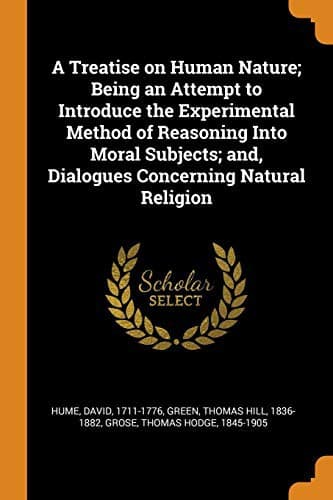
A Treatise of Human Nature: Being an Attempt to Introduce the Experimental Method Into Moral Subjects; and Dialogues Concerning Natural ReligionHume, David
PhilosophyPhilosophy
A Treatise of Human Nature: Being an Attempt to Introduce the Experimental Method Into Moral Subjects; and Dialogues Concerning Natural Religion
Hume, David
Emotions; Ethics; Knowledge, Theory of; Philosophy, English
310. ‘Ideas that we _have not_;’ for no one of the fictions by
which we elude the contradictions, nor indeed any one of the
contradictory judgments themselves, can be taken to represent an
‘idea’ according to Hume’s account of ideas. He allows himself indeed
to speak of our having ideas of identical objects, such as _this
table while I see or touch it_--though in this case, as has been
shown, either the object is not identical or the idea of it cannot
be copied from an impression--and of our transferring this idea to
resembling but interrupted perceptions. But the supposition to which
the contradiction involved in this transference gives rise--the
supposition that the perception continues to exist when it is not
perceived--is shown by the very statement of it to be no possible
copy of an impression. Yet according to Hume it is a ‘belief,’ and
a belief is ‘a lively idea associated with a present impression.’
What then is the impression and what the associated idea? ‘As the
propensity to feign the continued existence of sensible objects
arises from some lively impressions of the memory, it bestows a
vivacity on that fiction; or, in other words, makes us believe the
continued existence of body’. [1] Well and good: but this only
answers the first part of our question. It tells us what are the
impressions in the supposed case of belief, but not what is the
associated idea to which their liveliness is communicated. To say
that it arises from a propensity to feign, strong in proportion to
the liveliness of the supposed impressions of memory, does not tell
us of what impression it is a copy. Such a propensity indeed would be
an ‘impression of reflection,’ but the fiction itself is neither the
propensity nor a copy of it. The only possible supposition left for
Hume would be that it is a ‘compound idea;’ but what combination of
‘perceptions’ can amount to the existence of perceptions when they
are not perceived?
[1] P. 496. [Book I, part IV., sec. II.]
Comparison of present experience with past, which yields relation of
cause and effect, pre-supposes judgment of identity;
Public-domain text, read in full here on John Shaqi.
Reviews
Reviews
No reviews yet
Be the first to share your thoughts on this work.
Elsewhere in the archive
Join the Discussion
Join the discussion
Sign in to leave a comment or review.
Sign InorCreate an account